


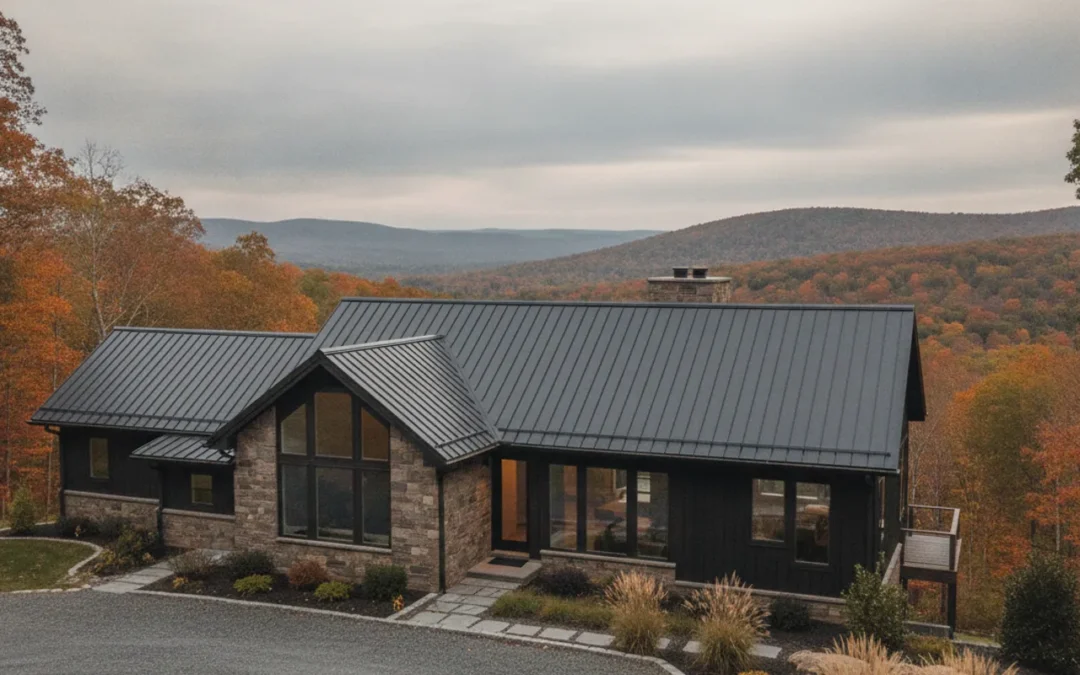
Metal roof repair starts with the path water takes, not the stain you see indoors. A loose fastener, an open seam, or a tired flashing can send water along a panel before it shows up on a ceiling. In Northeast Pennsylvania, snow, ice, wind, and hard rain make those details wear out faster. Look from the ground, write down what changed, and let a roofer get on the roof.
Request a metal roof repair estimate
What metal roof repair actually covers
A metal roof is a set of parts that have to work together. Panels shed water. Seams and fasteners hold those panels. Flashings close the gaps at walls, pipes, chimneys, and valleys. Underlayment and decking sit below the metal. A useful repair fixes the failed part and the route water used to get inside.
Covering only the drip you can see often leaves the real opening in place. Water can travel along a rib, a lap, or a framing member before it drops. That is why two roofs with the same ceiling stain can need very different work.
The roof profile also changes the repair. An exposed-fastener panel, common on many homes, shops, and agricultural buildings, is held down with screws through the face of the metal. A standing-seam roof hides most fasteners and relies on folded seams and clips. A patch that fits one system can be the wrong part for the other.
MNM Roofing Professionals installs and repairs metal roofing for homes and buildings across Northeast Pennsylvania. The residential roofing page lists metal roofing alongside shingle and rubber options. Crews are in-house, not subcontracted, and the company is licensed and insured.
Which roof details fail first
Most metal roof leaks start at a connection, not in the middle of a sound panel. These are the details worth naming before anyone talks about a full replacement.
Exposed fasteners and washers
Screws with rubber washers are a common leak point on exposed-fastener panels. Sun, heat, and cold harden the washer. A screw can also back out as the panel expands and contracts. You may see a dark ring, a loose screw head, or a rust streak running down from the fastener.
A sound repair replaces the failed fastener with the right type and a new washer, often one size larger so it bites fresh metal. Smearing sealant over a loose screw is a short-term cover, not a fix. If many screws in one area are loose, the panel attachment itself needs a closer look.
Seams, laps, and sealant
Panel laps and folded seams need a continuous seal. On some systems that seal is a butyl tape or a factory joint. If the seal is missing, dried out, or gapped, wind-driven rain can enter even when the panels look straight. A thin wire of sealant squeezed on top of a lap rarely replaces a seal that belongs inside the joint.
Roofing engineers who inspect metal roofs treat a misaligned lap as a different problem from a worn washer. If panels do not line up, closures do not fit, or gaps are too wide for the original seal, a surface coating will not correct the install. The Metal Roofing Alliance also warns that field-applied sealant on panel laps is not a substitute for the seal the system was built with.
Flashing and penetrations
Pipes, skylights, chimneys, and wall transitions move differently from the roof panels. Their flashings take the movement. Cracked boots, open counterflashing, and loose valley metal show up after freeze-thaw cycles and high wind. Types of roof flashing explains where each piece belongs. A metal roof repair at a penetration usually means removing the old flashing, cleaning the opening, and rebuilding that detail, not painting over it.
Panel damage, rust, and trim
A fallen branch, a footstep in the wrong spot, or wind-blown debris can crease or puncture a panel. Light surface rust is not the same as a hole. Edge rust at a cut, a rusted ridge cap, or a dent that opened a seam is more serious. Trim at eaves, rakes, and ridges also loosens and lets water in behind the panels.
Snow guards and gutter ties can fail too. If meltwater is overshooting the gutter, the leak may be at the eave, not in the field of the roof. The gutter installation page is the right place for drainage work that is separate from the panels.
What you can check before a roofer arrives
Stay off the roof. Metal is slick when it is wet, icy, or dusty, and a bad step can dent a panel or open a seam. Use the ground, a window, and binoculars.
- Note the date, the weather, and where water showed up inside. A stain after wind-driven rain points to a different spot than a drip during a slow thaw.
- From the ground, look for loose screws, rust streaks, open flashing, dented panels, and trim that has pulled away.
- Check the attic only if the floor is safe and you do not touch wet insulation. Look for daylight at penetrations and dark streaks on the deck, then leave.
- Photograph each finding in daylight. Include a wide shot so the location is clear, then a closer shot of the detail.
- Write down roof age if you know it, plus any earlier patches, coatings, or solar work.
- Call for an assessment if water is active, a panel is open, or you see sagging. Do not climb up to tighten screws yourself.
After a storm, use the roof inspection checklist after a Pennsylvania storm for the first safe pass. If shingles, siding, or fences also moved, the wind damage documentation guide shows how to record what you can see without guessing at the cause.
How a roofer traces a metal roof leak
A careful visit starts with your notes, then the outside of the building. The roofer looks at the stain or drip from inside, then works upslope and across the roof for the opening that could feed it. On metal, that opening is often higher than the stain.
They identify the system first. Exposed-fastener panels, standing seam, and agricultural profiles such as Master Rib or corrugated panels do not share the same parts. MNM lists several of those panel profiles on its residential page. Matching the profile matters before anyone orders a replacement sheet or a closure.
Next they test the likely details. Fasteners get checked for back-out and crushed washers. Laps get checked for gaps. Flashings get checked for movement and failed sealant. Valleys, eaves, and wall transitions get extra time because water is steered there on purpose. If the deck feels soft or the ceiling is sagging, the visit shifts from a surface repair to a structural question.
You should leave the visit with a plain description: what failed, where it is, what the repair includes, and what is not included. Ask whether nearby fasteners or flashings are worn enough to fail next. Fixing one screw while twenty others are cracked only delays the next call.
Repair, partial replacement, or a bigger project
A localized repair is reasonable when the metal is still sound and the failure is limited. Examples include a handful of failed fasteners, one punctured panel, a pipe boot, or a section of loose trim. The rest of the roof should still be fastened, aligned, and free of widespread rust-through.
Broader work belongs on the table when the same defect shows up across many panels, when laps were never sealed correctly, or when panels are bent out of line. A coating or a bead of surface sealant can slow a leak for a season. It does not pull misaligned panels back into place. Industry inspectors treat that kind of topical cover as a temporary measure, not a permanent correction.
Age alone does not decide it. A well-installed metal roof can serve for decades. A poor install can leak early. If the quote for repeated patches is climbing toward the cost of new panels in the damaged area, ask for both prices in writing. For a general look at how repair pricing is built in this region, see roof repair cost in Northeast Pennsylvania. That guide is not a metal-roof price list.
| What you see | Likely repair path | Ask before you approve |
|---|---|---|
| A few loose screws or cracked washers | Replace those fasteners with the correct screw and washer | How many nearby fasteners are in the same shape? |
| One puncture or small dent that opened a seam | Panel patch or a single panel replacement | Will the new piece match the profile and finish? |
| Failed pipe boot or wall flashing | Remove and rebuild that flashing detail | Is the deck under the opening still solid? |
| Open laps on many panels, or panels out of line | Section replacement rather than surface sealant | Can the original layout be corrected, or is replacement clearer? |
| Rust-through, soft deck, or sagging | Open the area and repair decking plus metal | How far does the damage extend past the stain? |
| Leak only at the eave during thaw | Check eave trim, ice buildup, and gutters | Is this a roof detail, a drainage issue, or both? |
Commercial buildings add access, tenants, and drainage that homes do not. If the property is a business, start with the commercial roof repair guide, then ask for a metal-specific look at panels and seams. Agricultural buildings with exposed panels raise profile questions covered in the agricultural building roof panels article. Choosing a new profile is a different job from repairing the one you have.
Pennsylvania weather and metal roofs
Northeast Pennsylvania gives metal roofs a hard cycle. Summer heat expands panels. Winter cold contracts them. That movement works fasteners loose over the years. Ice at the eave can back water up under trim even when the field of the roof is fine. Wind can lift a loose ridge or peel a flashing that was already tired.
Snow sliding off a slick metal surface is normal. Damage starts when the snow mass catches on a vent, a snow guard, or a gutter and bends the metal. Do not chip ice off the panels. You can cut the finish and open a seam that was not leaking before.
Leaves and needles in valleys hold moisture against the metal and against any flashing seal. A ground-level look each spring and fall is enough for most owners. If you want a second set of eyes without waiting for a stain, the roof inspection guide walks through what a visit should cover.
Metal and asphalt fail in different ways. If you are still deciding on a material for a replacement, the metal versus asphalt guide is the comparison. This article stays with roofs that are already metal.
What to ask before you approve the work
A clear proposal keeps the repair from turning into a surprise. Use these questions when you compare notes from a site visit.
- Which system is on the building, and which detail failed?
- Will the repair use matching panels, closures, and fasteners, or a coating over the old joint?
- What deck or underlayment work is included if the wood is wet?
- How will the crew keep the rest of the roof watertight while a panel is off?
- What workmanship warranty applies to this repair, and what is excluded?
- Is the price for one opening only, or for the worn fasteners around it?
MNM’s about page states that installations are handled by an in-house crew and that the company offers a 15-year craftsman warranty. Ask how that warranty applies to a repair versus a full installation, because a small fastener repair and a new roof are not the same scope. Free estimates are available through the contact page.
If an insurer is involved, share your photos and the roofer’s description of what failed. Do not widen the claim with damage you cannot see. Documentation is a record, not a diagnosis.
After the repair
Once the work is done, walk the inside of the building the next time it rains hard. Look at the old stain, not just the new metal. A dry ceiling after one storm is a good sign. Keep the photos from before and after so you can tell old marks from a new drip.
Ask what you should watch over the next year. Nearby washers, a rebuilt flashing, and eave trim are the usual follow-ups. Keep gutters clear so water does not sit against the eave. Skip roof walks, pressure washing, and store-bought coatings unless the roofer who did the repair says that product belongs on your system.
If a new stain shows up in the same spot, call back with the date and a photo. A return visit should start from the repair that was just made, not from zero.
Schedule a metal roof assessment
Frequently asked questions
Can I seal a metal roof leak myself?
A bucket and a towel can protect a floor during a storm. Caulk on a wet seam usually does not hold, and walking the roof can create a new dent. Save the repair for a roofer who can match the panel and the fastener.
Does a ceiling stain mean the panel above it is bad?
Not always. Water often runs along the panel or the deck before it drops. The opening can be a fastener, a lap, or a flashing several feet away from the stain.
When is replacement smarter than another patch?
Consider broader work when many fasteners have failed, panels are out of line, or rust and soft decking go beyond one spot. One worn pipe boot on an otherwise sound roof is still a repair.
Do Northeast Pennsylvania winters damage metal roofs?
The cold itself is not the problem. Expansion and contraction loosen fasteners, and ice at the eave can force water under the trim. Falling ice tools can scratch panels, so leave removal to people equipped for it.
How do I get an estimate from MNM Roofing?
Call (570) 793-5715 or use the contact form. Share photos, the date the leak started, and whether the building is a home, a shop, or a commercial property. An in-house estimator can tell you what the visit will cover.