


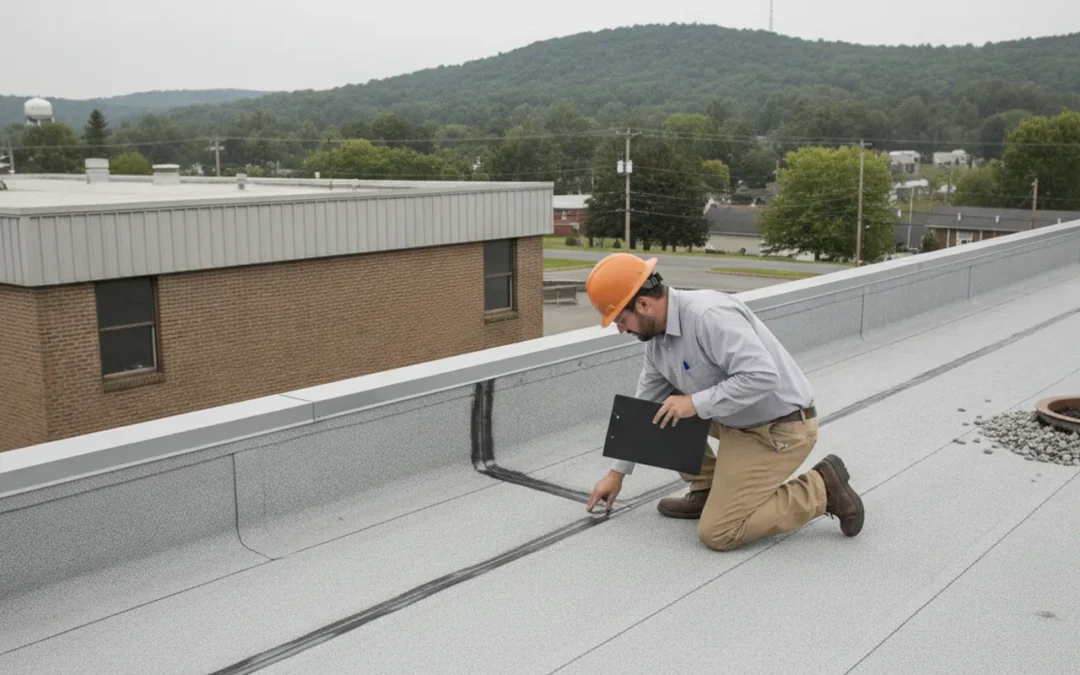
Commercial roof inspection cost is not a single flat figure for every building. The price depends on roof size, access, system type, inspection scope, and whether the visit is a routine condition review or a response to a specific concern. For Northeast Pennsylvania owners, a clear proposal should explain what the inspector will examine, what is excluded, and what you will receive afterward.
Request a commercial roof assessment
What is the short answer to commercial roof inspection cost?
Expect the cost to be determined by the work involved rather than by the word “inspection” alone. A compact, accessible roof with a straightforward visual review takes a different level of effort from a large, multi-section property with several roof systems, restricted access, or documented leak concerns. Some contractors may include a basic review as part of a larger estimate visit; others may quote a separate fee for a defined inspection and written findings.
Because pricing practices and scopes vary, avoid relying on a generic online number as a quote for your building. Ask what the fee covers and whether it includes a site visit, photographs, a written condition summary, recommendations, and a discussion of urgency. If the purpose is to price a repair or replacement, clarify whether the inspection fee is separate from the project estimate.
Which factors change the inspection price?
A useful quote reflects the conditions that influence time, access, and the level of documentation required. These are the main items to discuss before scheduling:
- Roof area and layout: A larger roof or one divided into wings, elevations, or additions requires more ground to review and organize.
- Roof system: A low-slope membrane, metal roof, and shingle-covered section have different seams, edges, penetrations, and drainage details to assess.
- Access and safety planning: Height, locked roof access, ladders, rooftop equipment, and site rules can affect how the visit is planned. No one should access a roof without appropriate safety measures.
- Inspection purpose: A routine baseline review differs from investigating an active leak, storm concern, recurring ponding, or a proposed project.
- Documentation: A verbal walkthrough is not the same deliverable as labeled photographs, a written report, a repair priority list, or records suitable for facilities planning.
- Number of buildings: Multiple structures on one property can add travel between roofs and separate findings that need to be tracked.
- Coordination requirements: Tenant schedules, operating hours, escort requirements, and equipment shutdown procedures may add time.
These factors do not mean every complex roof needs an elaborate report. They help explain why two proposals with similar labels may not cover the same work.
How do roof size and configuration affect cost?
Square footage is a starting point, not a complete description of difficulty. A broad roof with a simple perimeter may be easier to review than a smaller roof crowded with mechanical equipment, skylights, curbs, drains, and transitions. Multiple additions can also have different ages or roof coverings, so an inspector may need to record each section separately.
When requesting a quote, share the building address, approximate roof area if known, number of structures, and a simple description of the layout. If you have a roof plan or prior report, ask whether the contractor can use it to define the scope. A plan can help identify roof sections, but it does not replace an on-site review of current conditions.
Does the roof material matter?
Yes. Inspection details should fit the system rather than treating every commercial roof as interchangeable. Common commercial systems include low-slope rubber or other membrane roofing, metal roofing, and rolled roofing. An inspection should account for the visible features and likely water paths associated with the actual roof.
For example, a low-slope roof review may focus on seams, flashing transitions, drains, scuppers, and areas where water appears to remain. A metal roof assessment may examine panel joints, fasteners, penetrations, and flashing. On a shingle section, the reviewer may look at the field, edges, valleys, and penetrations. These examples describe topics to ask about, not a promise that every inspection includes invasive testing or repairs.
If a property has more than one roof type, list them separately when requesting proposals. This helps avoid a scope that names only the main building while leaving a smaller addition or canopy unclear. MNM Roofing offers commercial roofing services; see its commercial roofing and gutter services page for the service overview.
What should a commercial roof inspection cover?
The inspection scope should match the building and the question you need answered. For a general condition review, ask whether the proposal includes the following visible areas where applicable:
- Roof covering and visible signs of wear, displacement, damage, or previous patching.
- Seams, laps, fasteners, and transitions appropriate to the roof system.
- Flashing at parapets, walls, curbs, penetrations, and roof edges.
- Drainage components such as drains, gutters, and downspouts, plus visible signs of blocked flow or water retention.
- Roof-mounted equipment and nearby details that can affect the roofing surface.
- Interior clues provided by the owner, such as ceiling stains or leak locations, when those clues can be correlated with roof areas.
- Photographs or notes that identify where an observed condition is located.
A visual inspection has limits. A contractor should state if concealed layers, wet insulation, structural conditions, or other hidden components cannot be confirmed without separate testing or opening the assembly. Avoid treating a visual visit as a guarantee that no hidden defect exists.
How does an inspection differ from an estimate visit?
An estimate visit is generally focused on understanding a potential repair or replacement so the contractor can define proposed work. A broader condition inspection may document the overall roof, note concerns beyond one requested repair, and organize recommendations by location or priority. The actual distinction depends on the written scope.
Ask the contractor which of these outcomes you are buying:
- Project estimate: A proposal for a defined repair or replacement, often centered on a reported problem or planned project.
- Condition assessment: A review of roof areas with findings and recommendations, potentially including photographs and priorities.
- Special investigation: A focused effort to understand a leak or recurring condition, which may require additional access or testing outside a standard visual visit.
If you need both a broad assessment and a price for specific work, say so before the visit. The proposal can then distinguish inspection findings from the work estimate and avoid assumptions about what is included.
What are the common inspection options?
Use this comparison to identify the scope that fits your immediate need. It is not a price list: the provider should quote the actual building and deliverables.
| Option | Best suited to | Typical scope to clarify | Key limitation |
|---|---|---|---|
| Estimate visit | A known repair or replacement question | Area of concern, proposed work, and estimate details | May not document the entire roof |
| Visual condition review | Understanding visible condition across defined roof sections | Access, roof areas, photos, written notes, and priorities | Does not confirm concealed conditions |
| Leak-focused assessment | A reported leak or recurring water entry | Interior clues, likely roof area, and whether testing is included | Tracing water can require additional investigation |
| Multi-building review | Properties with several structures or roof systems | Building-by-building coverage and separate findings | Incomplete building lists can leave gaps |
What should you ask before accepting a proposal?
Compare the scope, not just the fee. Before approving an inspection, get clear answers to these questions:
- Which roofs and sections are included? List all buildings, additions, canopies, and roof levels that matter.
- What access is assumed? Confirm who will provide keys, escorts, roof hatches, or other access arrangements.
- What will I receive? Ask whether there will be a written summary, photographs, condition descriptions, and recommended next steps.
- Will findings be prioritized? Request a distinction between urgent concerns, routine maintenance, and conditions to monitor.
- Are repairs or testing included? Do not assume the inspection fee includes leak testing, destructive investigation, or repair work.
- How are additional services approved? Establish that any work beyond the agreed scope needs authorization.
- Does the report explain limitations? A sound proposal should identify areas that could not be accessed or confirmed.
For help preparing the project information, review this guide to a commercial roofing estimate. It covers the information that helps make a roofing proposal easier to evaluate.
How can you compare two inspection quotes fairly?
Put the proposals side by side and check whether they cover the same property and deliverables. A lower fee may reflect a shorter visit or fewer written findings; a higher fee may include broader documentation or extra structures. Neither is automatically better. The important question is whether the scope answers your concern.
Make a simple comparison with columns for each building, roof area, system, access assumptions, inspection method, deliverables, exclusions, and fee. Mark any item that is missing as “not stated,” then ask the contractor to clarify it in writing. This is more useful than comparing a single total without knowing what was priced.
Also confirm whether the report is intended for maintenance planning, a repair decision, or another purpose. If you need records for your own facilities team, ask for clear locations and dated photographs. If you need a repair estimate, ask whether it will be provided separately from the inspection findings.
When might a separate assessment be worthwhile?
A focused or more detailed assessment may be appropriate when the basic visual review cannot answer the question. Examples include recurring leaks with no obvious source, suspected moisture below the surface, or a roof condition that changes across several sections. The contractor should explain why additional work is proposed, what it can establish, and what it still cannot establish.
Do not authorize invasive testing simply because it sounds thorough. Ask what area will be opened, how the roof will be restored, whether the test is necessary to make the decision, and whether the cost is separate. For active water entry, explain the location and timing of the leak, and ask what immediate steps are safe while a professional assessment is arranged.
How should Northeast Pennsylvania owners prepare?
Preparation can make a scheduled visit more focused. Before the inspector arrives, gather available records and note the concerns that prompted the request. Useful information includes the approximate building age, known roof installation or repair dates, prior proposals, warranty documents, and a plan showing separate structures or roof sections.
Write down where interior signs have appeared and when they occur. A ceiling stain, damp area, or leak during a particular weather event can help guide the discussion, though water may travel before it becomes visible indoors. Do not climb onto a roof to take photographs or investigate a suspected leak.
Coordinate site access and tell the contractor about operating hours, tenant areas, restricted zones, rooftop equipment, and any required safety procedures. Northeast Pennsylvania weather can bring snow, ice, and storms that affect access and timing. If conditions make roof access unsafe, a visit may need to be rescheduled or limited; ask what can still be assessed from safe locations.
For broader planning, use MNM Roofing’s commercial roof maintenance guide and its commercial roof repair planning resource. These can help organize maintenance questions and the operational impact of repair work.
How do inspection findings guide the next decision?
An inspection is most useful when it turns observations into a practical next step. A report may identify conditions to monitor, recommend maintenance, or point toward a repair estimate. If the roof is nearing a larger project, findings can help define which sections need attention and what information is still missing. They should not be read as a guarantee of future performance or a substitute for reviewing the full proposal.
Ask the contractor to explain the reasoning behind each recommendation. Which observation supports it? Is the issue localized or repeated? What is the consequence of waiting, and what evidence would change the recommendation? These questions help owners distinguish immediate needs from longer-term planning.
If more than one solution is offered, request a written comparison of the work, affected areas, exclusions, and expected maintenance implications. Keep the report with other building records so that future reviews can compare the same locations and conditions.
How do inspection needs differ by building type?
Commercial property is not one uniform category. A small retail building, a warehouse, a multi-tenant office, and a group of agricultural or storage structures can present very different access and documentation needs. Describe how the building is used, which areas must remain accessible, and whether the roof includes additions installed at different times. This helps the contractor propose a scope that fits the property rather than assuming every roof section is alike.
Retail and customer-facing properties
For a store or restaurant, coordinate the visit around customer traffic, deliveries, and employee access. The roof itself may be simple, but rooftop equipment, signs, service access, and public entrances can affect the safe route to the inspection area. Explain whether a leak has affected a sales floor, stockroom, kitchen, or other area so findings can be matched with the reported location. Ask how the inspector will avoid disrupting normal operations and whether any staff member needs to accompany the visit.
Warehouses and industrial buildings
A large roof can contain long spans, multiple drainage zones, skylights, vents, and mechanical equipment. The facility may also have restricted areas or active loading operations. Ask whether the proposal identifies roof zones by a consistent numbering system or plan, and whether findings will be located clearly enough for maintenance staff to act on them. If interior access is part of the review, explain any production or safety restrictions in advance.
Multi-tenant buildings
In a multi-tenant property, the owner may need to coordinate interior access with several occupants. A roof inspection may be primarily external, but reports of stains or leaks from tenants can help identify where to investigate. Collect each report with its approximate date, room, and weather conditions. Keep tenant information organized, and clarify who is authorized to approve additional work if an issue is found.
Properties with several structures
Where a site includes a main building and separate garages, workshops, or storage structures, make an inventory before asking for a price. Note the address or name used for each building, its approximate dimensions, and known roof covering. Do not assume a quote for the main building includes every structure on the lot. A written list avoids later confusion and allows the contractor to describe each roof separately.
What is the difference between a visual review and testing?
The phrase “roof inspection” can describe different levels of work. Most owners start with a visual review of accessible surfaces and details. That review can document observable conditions, but it does not automatically reveal the condition of concealed materials. A proposal should name the method, the areas accessible, and any limits that apply.
Additional diagnostic work may be considered if observations and reported symptoms do not identify the source of a problem. The exact method depends on the roof assembly and the question being investigated. Such work may require separate equipment, additional time, access planning, or openings that must be restored. Before approving it, ask what uncertainty the test is meant to reduce and how the result will guide a decision.
Keep these distinctions in mind when reading a proposal:
- Observation: The reviewer documents visible conditions and accessible details.
- Investigation: The reviewer follows a specific symptom, such as recurring water entry, to gather more information.
- Testing: A defined procedure is used to evaluate a suspected condition; ask exactly what it can and cannot establish.
- Repair: Work is performed to address a condition, which may be separately priced and authorized.
A single visit might include more than one of these elements, but that should be clear in writing. Do not infer that testing or repair is included merely because a proposal uses the word “inspection.”
How should you interpret the written findings?
A useful report separates observations from conclusions and recommendations. An observation describes what was seen and where. A conclusion explains why that condition may matter. A recommendation describes a next step. Keeping those elements distinct makes it easier for owners and facility teams to decide what to do without overstating what the visit established.
Look for the location of each item, an explanation in plain language, and a photograph or other reference where available. If the report says “repair flashing,” ask which transition is involved and what work is proposed. If it notes standing water, ask where it was observed and whether the visit established the reason. If it recommends replacement, ask which findings support that recommendation and whether localized options were considered.
Reports may use urgency labels such as immediate, near-term, or monitor. These labels are useful only when their meaning is explained. Ask what action is expected, what could happen if it is delayed, and whether a temporary measure is being recommended. A label alone should not replace a description of the condition.
It can help to create a follow-up log with four fields: location, finding, action, and completion date. Keep invoices, photographs, and repair details with the inspection report. Later, this record can show what changed and which areas have already received attention. For a property with multiple roof sections, use the same names or map references in every record so comparisons remain meaningful.
What should an inspection report not promise?
No visual inspection can promise that a roof will not leak or that no concealed issue exists. Weather exposure, hidden layers, building movement, and conditions that develop after the visit can affect a roof. A responsible report explains its limits, including areas not accessed and components that could not be confirmed without separate investigation.
Be cautious of broad statements that lack a defined scope. Ask the contractor to clarify whether the opinion applies to the entire roof or only an accessible portion, whether it describes current visible condition or predicts service life, and whether any warranty or guarantee is being offered. Do not assume a condition report is a warranty, engineering evaluation, or certification unless the written terms explicitly say so.
If the report is intended for a transaction, insurance matter, or compliance requirement, state that purpose before scheduling. Different recipients may require particular credentials, formats, or testing. Confirm that the proposed service can satisfy the actual requirement; a general contractor’s visual assessment may not be the document a third party expects.
How can owners make inspection records more useful over time?
Inspection costs are easier to evaluate when each visit adds information to a usable building history. Keep the date, weather context if known, roof sections covered, photographs, findings, and completed work together. When the next inspection is scheduled, provide the prior record and ask whether the same areas can be revisited. This gives the reviewer a reference point without assuming that earlier conclusions remain current.
Label photos by building and roof zone instead of saving a folder of unmarked images. If the contractor supplies photographs, ask that the location be stated in captions or notes. Make a short record whenever maintenance staff observe a new stain or drainage concern: the date noticed, its indoor location, whether it followed rain or snow, and any steps already taken. These notes can make the discussion more specific and prevent repeated searching for basic facts.
For owners planning capital work, combine inspection records with the building’s known repair history and planned occupancy changes. That does not produce a guaranteed replacement date, but it can help organize priorities and budget discussions. Separate confirmed needs from assumptions, and update the plan when new findings or repairs change the condition.
What mistakes can lead to a confusing inspection quote?
Several avoidable gaps can make an inspection proposal difficult to compare or result in a visit that does not answer the owner’s question:
- Requesting “a roof inspection” without stating why: Explain whether you need a general baseline, a leak investigation, or information for a repair decision.
- Leaving out buildings or additions: Identify every roof you expect included instead of relying on an assumption about the property.
- Providing no symptom history: A brief timeline of leaks, repairs, or visible changes can direct attention to relevant areas.
- Assuming the report includes a repair quote: Ask whether pricing for corrective work is a separate deliverable.
- Failing to discuss access: Locked hatches, tenant coordination, and site safety rules can affect the planned visit.
- Comparing totals with different scopes: Normalize areas, deliverables, and exclusions before judging fees.
- Expecting hidden conditions to be confirmed visually: Ask what additional investigation would be needed if concealed materials are in question.
Clear information at the start benefits both sides. The property owner gets a proposal that matches the need, and the contractor can explain what can reasonably be assessed during the visit.
How should you handle an urgent leak before the inspection?
If water is entering the building, protect people first. Keep occupants away from wet electrical areas and unstable ceilings. Follow the property’s safety procedures, protect contents only when it is safe to do so, and contact an appropriate roofing professional to discuss the condition. Do not climb onto a wet, icy, or damaged roof to locate the source.
Record the affected interior area and the time the leak was noticed. If safe, take photographs from inside and move vulnerable equipment or inventory away from water. Tell the contractor whether the leak is active, whether it changes with weather, and whether any temporary measures have already been taken. A scheduled condition review may not be the right response to an active emergency, so explain the urgency when you call.
Once immediate concerns are addressed, request written notes about any temporary work and whether a follow-up inspection is recommended. Temporary measures are not the same as a completed repair, and a later assessment may still be needed to identify the cause and extent of the problem.
How do weather and season affect scheduling?
In Northeast Pennsylvania, snow, ice, rain, and wind can affect roof access and the usefulness of observations. A contractor may be unable to safely access a roof under certain conditions. Wet surfaces can also limit what can be seen, while snow may cover portions of the roof. Ask whether the planned visit depends on roof access and what happens if conditions require a change.
For a routine review, scheduling ahead can give the property team time to gather records and coordinate occupants. After a storm or a new leak, report the issue promptly and describe the observed condition rather than waiting for a preferred season. Weather does not determine a universal inspection schedule; building use, roof condition, repair history, and owner requirements all matter.
If the visit is rescheduled or some areas cannot be accessed, request a written note identifying the limitation and any recommended follow-up. That way, the report does not imply that the entire roof was reviewed when conditions prevented it.
How can a property manager coordinate the process?
A property manager can make an inspection more efficient by appointing one site contact, collecting tenant observations, and preparing access instructions. Share the contact’s phone number with the contractor and identify who may approve additional services. If multiple staff members attend, agree on the questions to cover so that the site visit stays focused.
Afterward, circulate the findings to the people responsible for maintenance, operations, and budget decisions. Separate the report’s observed conditions from proposed work and assign an owner to each follow-up action. For example, a facilities employee may clear an accessible drainage component while a contractor prepares a separate repair proposal for a flashing concern. Track completed actions rather than assuming that an item has been handled because it appears in a report.
When proposals are reviewed by a board or ownership group, present a short comparison that includes fee, scope, deliverables, limitations, and proposed next steps. Attach the full documents for reference. This creates a clear decision record and reduces the chance that a low quote is selected without understanding what it leaves out.
How can you turn a vague request into a defined scope?
A quote request is easier to evaluate when it describes the decision you are trying to make. “Tell me what shape the roof is in” may mean a broad visual review to one owner and a detailed, mapped report to another. Before contacting contractors, write a two- or three-sentence scope brief. State the property, the sections to include, the reason for the visit, and how you expect to use the findings. This does not need to prescribe the inspection method; it gives the contractor enough context to recommend one.
For example, an owner planning a maintenance budget might say: “Review the main warehouse and attached office roof, document visible conditions by roof zone, and identify items that need action now versus items to monitor. We need photographs and a written summary for facilities planning.” Someone investigating a leak might instead say: “Water appeared in the east office after heavy rain on two occasions. Please assess the likely roof area, explain whether tracing or testing is outside the initial visit, and provide a separate repair proposal if the source is clear.” The second request keeps the known symptom distinct from the conclusion, which has not yet been established.
Describe the outcome you need without insisting on a particular answer. If the goal is to decide whether a repair is practical, ask for findings that identify the affected area and the basis for the proposed work. If the goal is a portfolio record, ask for consistent building labels and a repeatable format. If a lender, insurer, buyer, or other party requested documentation, share its exact instructions before booking. A standard contractor visit may not meet a third party’s format or qualification requirements.
What does a useful inspection workflow look like?
Thinking in stages helps owners understand what is being priced and what they can do to keep the process focused. A typical arrangement may include these steps, subject to the contractor’s stated scope:
- Define the question. Decide whether you need an overall condition snapshot, a response to a reported leak, or observations to support a repair or replacement decision. Write down what the report must help you decide.
- Describe the property. Identify buildings, roof levels, approximate dimensions, known materials, access points, equipment, and operating restrictions. Mark unknown details as unknown rather than guessing.
- Agree on coverage. Ask the contractor to name the included sections and any areas excluded because of access, weather, or safety conditions. For a multi-building site, make the building list part of the written scope.
- Confirm the method and deliverables. Clarify whether the work is visual, whether interior observations are included, and whether photographs, a written summary, a mapped location reference, or recommendations will be supplied.
- Set boundaries on additional work. Ask how the contractor will handle a condition that appears to need testing, opening, or immediate repair. Agree that work outside the approved scope requires authorization.
- Review and act on findings. Separate observed conditions from proposals. Assign each follow-up item to a person, request clarification where needed, and keep the resulting repair record with the report.
This sequence is useful even when a contractor uses a different process. The aim is not to make a simple visit unnecessarily formal; it is to prevent a mismatch between the fee and the answer you need. A short written scope can be enough to expose an important difference between two offers.
How can you build a practical quote comparison?
Use a comparison sheet to identify missing information rather than treating the lowest total as the automatic choice. Record the total fee, but give equal attention to what the provider has agreed to inspect and deliver. One proposal might include only accessible roof surfaces on the primary building. Another might include multiple structures, labeled images, and a written priority list. Those are different services, even if both are titled “inspection.”
Start with a row for every building or roof section. Then add rows for access assumptions, inspection method, interior review, photos, report format, recommended next steps, exclusions, timing, and the process for approving extra work. Put the proposal language into the relevant cell or mark it “not stated.” Avoid filling gaps with assumptions. Send the same concise clarification questions to each contractor so that the answers can be compared on equal terms.
For instance, suppose Proposal A includes the main building but does not mention the detached storage structure. Proposal B lists both buildings but does not say whether photographs are included. Do not compare their fees until you have asked whether the omitted building can be added to A and what documentation B will provide. The comparison may change once the scopes are aligned. If the prices remain different, ask what difference in time, access, or deliverable accounts for it rather than asking for a discount without context.
Also distinguish the inspection fee from the cost of recommended work. A report may identify a repair need without including that repair in the fee. Request a separate written work proposal that identifies its location, tasks, materials where applicable, and exclusions. Keeping assessment and construction pricing distinct makes it easier to understand what you are approving at each stage.
How should findings be translated into a facilities action plan?
Inspection notes become more useful when they lead to specific, trackable actions. For every finding, capture the roof section, observed condition, supporting photograph or note, suggested action, responsible person, and status. If a finding is unclear, write down the question to resolve rather than converting it into an assumed repair. This is especially helpful when reports are reviewed by people who were not present during the site visit.
Consider a report that mentions a damaged flashing transition near a rooftop unit. The immediate follow-up is not simply “fix roof.” Ask which unit or zone is involved, what damage was observed, whether the recommendation is to monitor or repair, and whether the contractor will provide a separate scope. If the report notes a blocked drain, confirm its location and who is responsible for clearing it. Record the action and completion date, then retain any work documentation. The record makes a later review more meaningful because the team can distinguish an old observation from an unresolved one.
For larger properties, assign consistent names to roof zones. A building plan with labels such as North Wing, Office Addition, and Loading Area can help staff discuss the same location. If a contractor uses a different map or numbering convention, retain that reference alongside your own. Do not rely on a photograph alone if it is difficult to tell where it was taken. A short caption can make a major difference when maintenance staff revisit the area months later.
Prioritize based on the report’s stated reasoning, operational risk, and the owner’s decision needs. A label such as “urgent” should prompt a question about the underlying condition and the recommended timeframe, not replace that explanation. Ask what the report establishes, what remains uncertain, and what information would change the next step. If a recommendation is broad, request a more specific description before using it to plan work.
When does an inspection fee need a closer explanation?
A fee deserves clarification when its scope is unusually vague, when it appears to bundle unrelated work, or when the proposal does not say what happens if access is unavailable. The issue is not that a contractor must use one standard format. It is that you should be able to understand the service being purchased and the circumstances that could alter it.
Ask for detail if the quote says only “inspect roof” with no listed buildings or sections. Ask whether a written report is included if the proposal promises an assessment but says nothing about documentation. If testing is described as possible, find out whether it is included, optional, or billed separately, and whether the contractor will ask before proceeding. If a fee is credited toward later work, request the exact terms in writing rather than relying on an informal understanding.
Likewise, ask what happens if weather prevents safe access or a tenant cannot provide entry. Does the contractor plan to reschedule, assess only the reachable areas, or return for a separate visit? The answer affects both usefulness and cost. A report should identify any portion that was not reviewed so that an owner does not mistake partial coverage for a complete roof assessment.
Do not assume that a higher fee guarantees a better report or that a lower fee means poor work. Compare the defined activities, experience relevant to the roof type, documentation, limits, and communication. A proposal that is clear about exclusions can be more useful than one with a larger list of vague promises.
How can owners prepare a building record before the visit?
A compact information packet can save time and help the contractor focus on the property’s actual question. It may include a site plan or simple building list, available roof plans, prior inspection notes, records of repairs, and any known installation dates. Include only records you have; do not delay a needed assessment while trying to reconstruct a complete history.
For leak concerns, make a symptom log. Record the room or area, date noticed, whether the condition was active or a stain, and the weather or operating circumstances you observed. Note whether it has happened before and whether any temporary action was taken. This is a report of what occupants saw, not proof of the roof source. Water can travel through a building before appearing indoors, so avoid marking a roof location as confirmed unless the investigation supports it.
Prepare access in advance. Identify the site contact, key or hatch arrangements, escort rules, restricted areas, and any site safety briefing. Tell the contractor about rooftop equipment and operational constraints. If interior access is expected, coordinate with the relevant tenant or department. Keep occupants away from areas that may be unsafe, and do not ask staff to climb onto the roof to gather information.
Finally, decide who can approve additional services. If the owner, property manager, and facilities lead share responsibility, establish who will receive the report and who can authorize a separate test or repair. This avoids confusion if the visit identifies a concern that needs prompt attention. For commercial roofing service information, review MNM Roofing’s commercial roofing page and its commercial estimate guide.
How can different stakeholders use the same report?
A building owner may be focused on cost and long-term planning, while a property manager needs to coordinate access and tenants. A facilities employee may need exact locations and clear work instructions. A board or ownership group may need a concise comparison before approving funds. A report can serve all of them if its findings are organized by location, the limitations are explicit, and recommendations are separated from proposed construction work.
When circulating findings, include a short cover note that answers three practical questions: what was reviewed, what needs a decision, and what remains uncertain. Attach the complete report and any proposal rather than paraphrasing technical findings as settled facts. If the report does not identify a location clearly, ask the contractor to clarify before assigning work. If different stakeholders have different priorities, list them openly—for example, stopping active water entry, avoiding disruption during business hours, and preserving a record for next year’s planning.
For a board discussion, a concise comparison table can show each option, the area covered, included deliverables, exclusions, and fee. Put unanswered questions next to the relevant item. This helps decision-makers see whether they are choosing between comparable scopes or deciding whether to buy different levels of information. Once the decision is made, record the approval, schedule, and any conditions attached to it.
How can you request a clear commercial roof inspection quote?
When contacting a contractor, provide the property address, building count, known roof types, approximate area, access details, and the specific question you want answered. Mention any active leaks, interior evidence, prior repairs, or recent weather concerns. Then request a written scope that identifies included sections, deliverables, limitations, and any additional services that could change the cost.
MNM Roofing serves commercial property owners in Northeast Pennsylvania and offers commercial roofing and gutter services. You can request a commercial roofing estimate in Whitehall or contact the team through the estimate request page. The team can discuss the property and the appropriate next step.
A clear inspection scope helps you understand what the fee covers, what the findings can tell you, and whether further work is needed before making a roofing decision.