


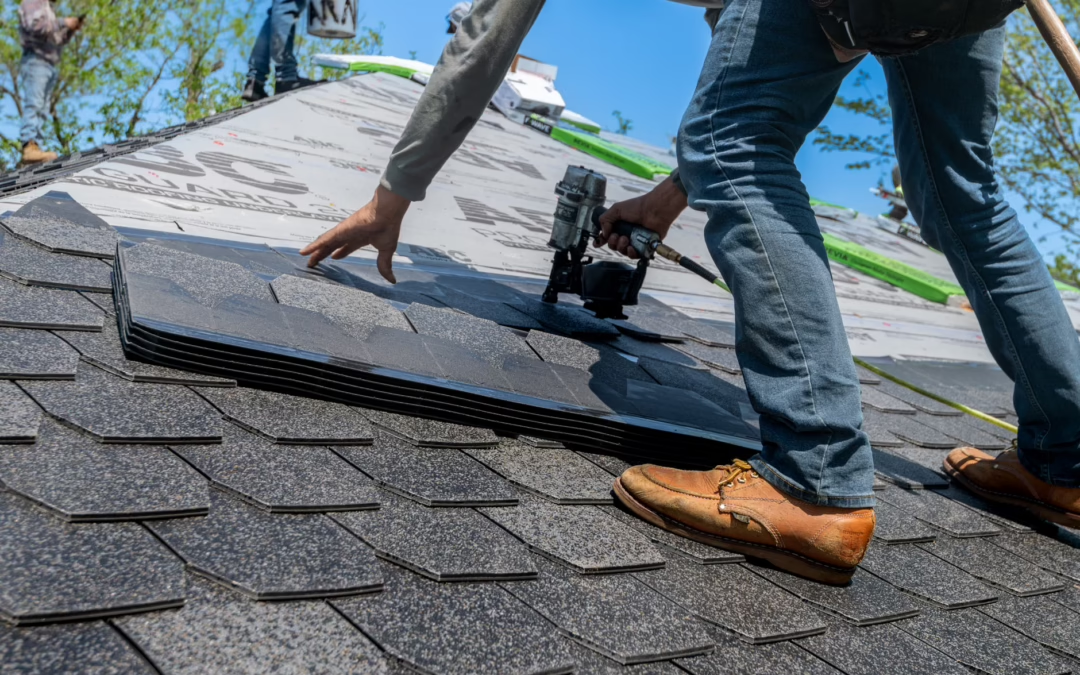
You’re in the driveway and the roof looks fine from the street. Then the afternoon sun hits it just right and you see it, a ripple running across the field of shingles, not at the ridge and not down at the eave. A week later you spot a couple shiny nail heads and one shingle tab sitting up like it never laid back down.
Around Greentown PA we see this after the weather swings (more on that in prepare your Greentown roof for the changing seasons), a warm spell in March, a cold snap in April, then sticky summer humidity. The roof dries, swells, dries again. If the house has older plank decking, or the attic ventilation is out of balance, the movement shows up right through the shingles.
Wavy shingles are not the same thing as a leak, and nail pops do not automatically mean you need a full tear-off tomorrow. They do mean something changed under the shingles, and it’s worth figuring out what before the wind gets under a lifted tab.
Waves in the middle of the roof usually point to movement in the deck
True “wavy shingles” in the field of the roof, not at a valley or flashing line, is often the roof deck telegraphing through. On a lot of older homes you’ll find 1x plank decking, commonly 1×6 or 1×8 boards, laid with small gaps between them. Those boards take on moisture in humid stretches and swell across the grain. When they dry out, they shrink back. That back and forth can print a subtle washboard look through asphalt shingles.
Plywood and OSB can do it too, usually where sheets were installed tight with no gap. Sheet goods are supposed to have a little room at the edges (about 1/8 inch) so they don’t buckle when they pick up moisture. Buckling is different from a soft spot. Buckling makes a ridge. Rot feels spongy.
If the waves line up in long, straight runs, we start looking for deck seams and truss lines. If they’re random and pillowy, we start thinking heat and ventilation, because overheated shingles can relax and deform, then lock in that shape when they cool.
Nail pops happen for a few repeat reasons, and each leaves a clue
A nail pop is a fastener that backed out, or a nail that never bit into solid wood to begin with. You’ll see a round bump, sometimes with a pinhole, and sometimes the nail head is exposed and shiny. The clue is where it’s happening.
If pops are scattered everywhere, we look at fastening and substrate. A roofing nail needs to be long enough to go through the shingle, through the underlayment, through the deck, and still have a little bite. On plank decks, a nail can land in a gap and hold nothing. On thin or damaged decking, the nail can work loose with thermal movement.
If pops are in a line, that often matches a deck seam or a truss chord. Movement at that joint works the nail.
If pops show up after a windy stretch, the sequence is usually: tab lifts, nail gets tugged, then the nail slowly backs out. That’s why we treat a few pops like a warning light, not a cosmetic issue.
Humidity swings in NEPA push and pull the roof system, not just the shingles
Northeastern PA summers are hard on roof assemblies. You can have a cool night, then a hot, humid afternoon that drives moisture into wood. In winter, the attic can be warm and damp from the house, while the roof deck is cold. That’s the setup for condensation on the underside of sheathing.
Wood that cycles wet and dry moves. Asphalt shingles also move with temperature. A dark roof surface can run far hotter than the air temperature on a sunny day. That expansion and contraction stresses the fasteners and the bond between shingle courses.
Here’s the part homeowners miss: you can have no active leak and still have moisture loading the deck from below. Bath fans dumping into the attic, a disconnected dryer vent, or an attic hatch with no weatherstripping can add enough moisture to make the deck swell. Over a few seasons, that swelling can show up as mid-roof waviness, and it can help nails work loose.
We don’t guess on this. We look for staining on the underside of the deck, rusted nail tips, and frost marks in winter. Those are checkable signs that the attic environment is part of the story (this ties in with why Greentown homes keep getting attic condensation and shingle blisters).
Old plank decking needs different fastening and prep than sheet decking
Plank decking can last a long time, but it changes how a shingle roof behaves. The boards are individual pieces. They cup, crown, and shrink. The gaps between boards matter.
If a roof was reshingled years ago and the crew didn’t address wide gaps, nail placement becomes a game of chance. A nail that hits air will feel fine on install day and then pop later. That’s why we pay attention to nailing zones and we don’t “chase” a gap with angled nails, because that can cut the shingle mat and make things worse.
When we’re diagnosing wavy shingles, we also check for localized repairs where someone patched in a piece of plywood over planks. Mixed decking can create a hard transition line. The plywood stays flatter, the planks move, and the shingles telegraph the change.
If a full replacement is on the table, this is where the deck conversation happens (see residential). Sometimes the right fix is selective redecking, sometimes it’s adding an overlay, and sometimes the existing boards are fine with the right underlayment and fastening plan. The deck decides it, not a rule of thumb.
Ventilation balance matters more than raw vent area
Homeowners hear “add more vents” and assume more is always better. It’s not. A roof needs intake low and exhaust high, and it needs them working together. If you have a big ridge vent but the soffits are blocked, the attic can pull air from wherever it can, including through bathroom fan housings and ceiling penetrations. That brings warm, moist air into the attic.
A common target we work around is the 1/150 rule for net free vent area, or 1/300 if the balance and vapor control are right. The exact setup depends on the roof shape and the ceiling plane. The point is balance.
Mid-roof waviness can show up when the attic runs hot all summer. That heat bakes the shingles from below, especially over dark decking. Nail pops can follow because the deck dries, shrinks, and the nails lose grip.
We also watch for gable vents fighting ridge vents. If a house has active exhaust at the ridge and big gable openings, air can short-circuit from gable to ridge and skip the lower bays. Those bays stay hot and damp. That’s where you see the weird deformation that doesn’t match the rest of the roof.
How we check a wavy roof without guessing from the ground
Binoculars from the lawn only get you so far. The pattern matters, and so does what’s under it. We start by mapping where the waves and pops are. Field, near a hip, along a seam, or clustered around a roof penetration.
Then we look at the shingle itself. A manufacturing “wave” tends to be uniform and repeat at the same point on each shingle. A deck-driven wave ignores the shingle layout and follows framing lines.
A few practical checks we do on-site:
- Fastener check: lift a tab carefully and verify nail placement and depth. Overdriven nails cut into the mat. Underdriven nails hold the tab up.
- Deck feel: walk the area and feel for hard ridges (buckling) versus soft spots (deterioration). Different failure modes, different fixes.
- Attic read: look for darkened sheathing, rusty nail tips, and compressed insulation at the eaves. We also look for a bath fan duct that ends in mid-air.
If we can’t see the underside safely, we’ll use a light and mirror at the attic hatch or a camera. We’re looking for cause and effect. Fixing the symptom alone is how you end up chasing nail pops every spring.
Repairs that hold are about fastening, sealing, and stopping the movement
A popped nail can be handled the right way, but it has to be done like a roofer, not like a handyman with a tube of caulk. If a nail backed out, we don’t just pound it flat and walk away. That can crack the shingle and it rarely solves the reason it backed out.
Typical steps on a proper nail pop repair are: remove or lift the affected shingle section, replace the fastener with the correct roofing nail in solid wood, then seal the tab back down with asphalt roof cement where needed. We keep the sealant small and placed where it belongs, because blobs of cement collect grit and can telegraph through in hot weather.
For wavy shingles caused by deck movement, the long-term fix is reducing the movement. That can mean correcting attic ventilation balance, sealing attic air leaks at plumbing stacks and electrical penetrations, and making sure bath fans are ducted to the exterior with insulated flex or rigid pipe.
If the deck itself is buckling or broken, that’s a structural substrate issue. That’s where a roof replacement with deck repairs makes sense (timing matters too, see best time of year to replace a roof in Greentown PA), because shingles cannot lay flat over a moving, uneven base. Our crews would rather fix the base once than keep spot-repairing the surface.
Key Takeaways
- Mid-roof waviness often traces back to deck movement, especially on 1x plank decking with gaps and seasonal swelling.
- Nail pops are usually fastener bite problems, deck movement at seams, or wind lift tugging on a tab over time.
- Humidity swings can load the roof deck from below, even with no leak, especially from bath fans or attic bypasses.
- Ventilation is about balanced intake and exhaust, not just adding a ridge vent and calling it good.
- A repair that lasts replaces the fastener in solid wood and re-seals the shingle properly, it does not rely on surface caulk.
Conclusion
If you’re seeing wavy shingles in Greentown PA, or you’ve got nail heads starting to show, treat it like an early warning, not a panic. The roof is telling you something moved. Sometimes it’s a simple fastening issue in a small area. Sometimes it’s the attic running hot and damp and pushing the deck around season after season.
Our approach is straightforward. We find the pattern, confirm what’s happening underneath, and then fix the cause so you’re not calling again after the next humidity swing or wind event. If it’s a repair, we repair it clean. If it’s telling us the deck and ventilation need to be addressed as part of a replacement, we’ll show you why and walk you through the details on your house (start here: contact us).
External references that back up a few of the building-science points above: Energy Saver (U.S. Department of Energy), International Residential Code (ICC), and Owens Corning Roofing Installation Instructions.