


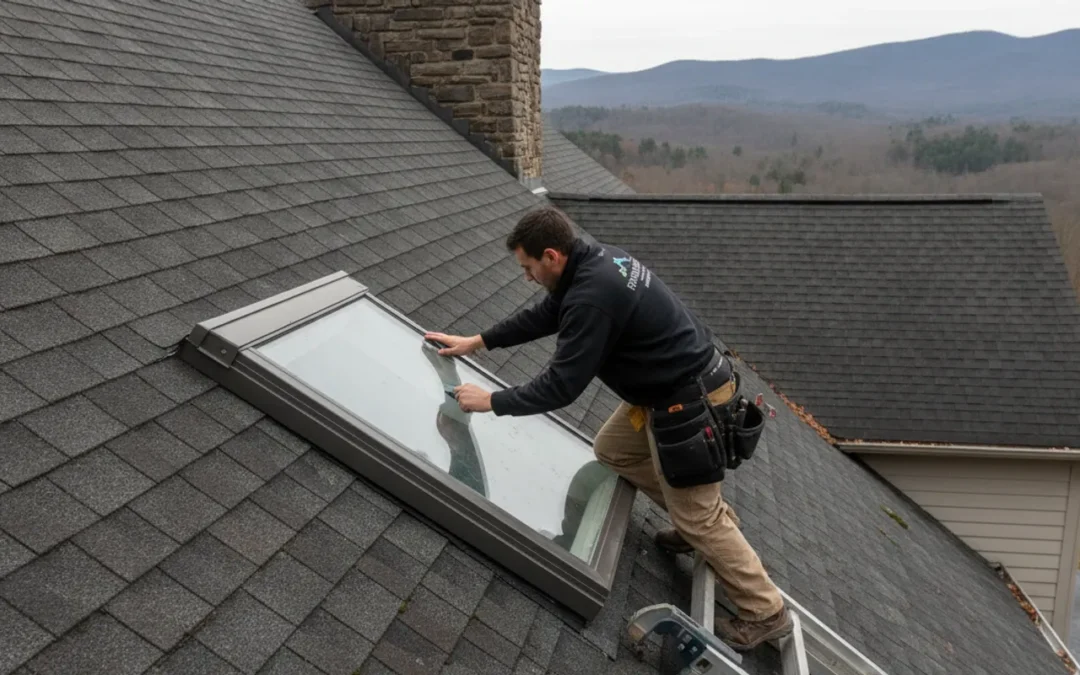
Skylight replacement cost depends on more than the price of a new unit. Size, roof pitch, access, flashing, interior finishes, and concealed damage can all change the work. If you are comparing options in Northeast Pennsylvania, begin by defining the scope: what is being replaced, what roof work is included, and where the contractor’s responsibility ends.
What does skylight replacement include?
A replacement can involve removing the existing unit, preparing the roof opening, setting a compatible new skylight, integrating flashing with the roof covering, and restoring nearby materials. A straightforward same-size replacement is different from a project that changes the opening or repairs damaged framing. Interior shaft and finish work may also be separate.
Do not compare a bare product price with a complete installation proposal. The product is only one part of the job. A useful written scope identifies the unit, removal, disposal, roof preparation, flashing, roofing restoration, protection, cleanup, and any interior work. It should also state how newly discovered damage will be handled. For homeowners seeking broader context, the company’s residential roofing services page describes the relevant service category.
- Unit: Size, type, operating method, and included accessories.
- Roof work: Removal, opening preparation, underlayment, flashing, and restoration of shingles or other roofing.
- Interior work: Whether the estimate includes the light shaft, trim, drywall, or paint.
- Contingencies: The approval and pricing process for concealed rot or water damage.
- Project terms: Cleanup, disposal, schedule assumptions, payment terms, and applicable product or workmanship documents.
Which factors affect skylight replacement cost?
Size, shape, and product type
A larger or nonstandard skylight may require a different unit and more adjustment than a common size. Fixed units do not open; venting units do. These choices affect the product and may affect installation details. Ask whether the proposed model fits the existing opening, and request a separate description if it does not. Confirm that any accessories or controls you expect are listed rather than assumed.
Matching the old unit’s outside dimensions is not always enough to establish compatibility. The contractor needs to consider the rough opening and the way the unit is designed to sit on the roof. If a replacement product is not a direct fit, the scope may require adjustments to the opening, roofing, or interior shaft. Ask what measurements were used and whether the estimate assumes reuse of the existing opening.
Roof pitch, height, and access
A steep roof, multiple stories, limited ladder access, or nearby obstacles can make safe access and material handling more involved. Ask whether the estimate reflects the actual height and pitch. A simple description of the home does not tell the whole story: a skylight over a lower roof may be approached differently from one high above landscaping, a deck, or an obstructed driveway.
Access also affects how materials and debris move. During an estimate, point out gates, narrow side yards, fragile landscaping, or areas that should remain clear. The contractor can explain what access assumptions are built into the scope. Do not climb onto the roof to gather measurements or photographs; use views from inside or from the ground.
Flashing and roof integration
Flashing helps direct water away from the unit and connect it to the roof covering. A replacement scope should explain what flashing work is included and how it relates to the surrounding roofing. The appropriate details depend on the unit, roof material, slope, and condition. A proposal that says only “replace skylight” leaves an important part of the water-management work unclear.
Ask whether the estimate includes new flashing or reuse of existing components, and how adjacent shingles or roofing will be restored. If the roof covering around the unit is brittle, damaged, or near the end of its service life, that condition may affect the proposed method. The estimator should distinguish observed conditions from possibilities that can only be confirmed after removal. See the guide to types of roof flashing for more background on why these transitions deserve attention.
Roof deck and framing condition
Water entering around an older unit can affect nearby decking or framing. Damage may not be visible until the old skylight and surrounding materials are removed. A clear estimate explains whether a limited amount of repair is included, whether an allowance applies, or whether additional work requires customer approval first.
Ask how the contractor will document hidden damage, explain the proposed repair, and get approval before proceeding. The process should be specific enough that you understand what can change the total and how the decision will be made. It should not present unseen damage as certain, nor leave you guessing about what happens if it is found.
Interior shaft and finishes
Some skylights sit close to the roof plane; others connect to the room through a deeper shaft. Removing and replacing the exterior unit does not automatically include repairing that shaft, drywall, trim, or paint. Clarify whether the roofing scope ends at the exterior or includes room-side restoration.
Look at the ceiling and shaft before the estimate visit. Note stains, peeling paint, soft drywall, or trim separation, but do not assume that a mark proves the skylight is the source. Ask who handles any interior work and whether that work is included, excluded, or listed as an option. If another trade will be needed, establish that boundary before scheduling.
Same opening or a changed opening
Replacing a unit in the existing opening is not the same scope as enlarging, relocating, or changing the shape of the opening. A changed opening can require additional framing, roof work, and interior restoration. If you want a different size or position, request a separate scope so you can compare a like-for-like replacement with the proposed alteration.
How do project scopes compare?
This comparison describes work to clarify, not a price quote. Actual costs depend on the selected product and conditions at the home. When comparing proposals, check that each one describes the same scope and assumptions.
| Project scope | Work to identify | Possible estimate variables |
|---|---|---|
| Same-size replacement | Remove old unit, fit compatible unit, integrate flashing, restore roof covering | Access, unit fit, roof condition, disposal |
| Replacement with roof repair | Replacement plus approved deck, flashing-area, or framing repair | Extent of concealed damage and approval method |
| Changed opening | New or adjusted opening, framing, roof integration, possible interior restoration | Structural needs, roof layout, room-side finish work |
| Replacement with interior work | Exterior replacement plus specified shaft, drywall, trim, or paint restoration | Shaft depth, finish condition, trades included |
How can you build a useful scope before asking for a price?
A price comparison becomes meaningful only after you define the outcome you want. Start with the problem, then separate desired improvements from required work. For example, a homeowner who has a leak may want the current unit repaired or replaced, but may also be considering a venting model. Those are distinct decisions. Ask for the basic repair or like-for-like replacement first, then have any upgrade described separately.
Make a simple project brief using what you can safely observe. Include the room beneath the unit, approximate age if known, whether it opens, any visible cracks or failed hardware, the location of interior moisture, and the weather or conditions when it appears. Add whether the roof is already scheduled for work. Avoid guessing at roof measurements or diagnosing a leak from a ceiling stain.
- Describe the symptom: State where water or condensation appears and when you notice it.
- Describe the goal: Say whether you want diagnosis, repair, like-for-like replacement, a different operating type, or a changed opening.
- Identify known boundaries: Mention whether interior finish work is desired and whether a separate trade is already involved.
- Ask for alternatives: Request separate scopes where repair and replacement, or retaining and changing the opening, are both plausible.
- Keep assumptions visible: Ask the estimator to note what could not be confirmed without removing the unit.
This preparation does not replace an inspection. It helps ensure that the estimate responds to the same question you are trying to answer, rather than pricing an assumed project that differs from your actual goal.
Repair or replace: how should you decide?
A leak does not automatically mean the skylight itself has failed. Water may enter at flashing, nearby shingles, or another roof detail. Condensation on the room side can also look like a leak. Record where moisture appears and when it happens: during wind-driven rain, after a thaw, or on cold mornings. These details help an inspection narrow the possibilities.
A repair may be suitable when the unit is sound and the issue is limited to a repairable roof detail. Replacement may be worth considering when the unit is damaged, hard to operate, repeatedly leaking after appropriate repairs, or no longer suitable for the roof assembly. The decision should follow an assessment of both the skylight and surrounding roofing, not just the ceiling stain.
If water is actively coming in, move belongings and catch drips if safe. Avoid climbing onto a wet, icy, or steep roof. Take photos from a safe location and arrange an inspection. For more context, read the roof inspection guide and review roof replacement versus repair.
What signs can help narrow the problem?
Homeowners can record observations without trying to perform a roof diagnosis. The timing and location of moisture are useful details, but they do not prove the source. A disciplined record can help the estimator ask better questions and avoid treating every stain as a skylight failure.
- Moisture on the glass: Note whether droplets form on the room-facing surface, especially during cold weather. This pattern may be different from water entering from outside.
- Staining at one corner: Record the exact ceiling or shaft location and whether it changes after rain or thaw. Water can travel before it becomes visible indoors.
- Draft or difficulty operating: Note whether a venting sash sticks, will not latch, or feels loose. Do not force a mechanism that may be damaged.
- Visible exterior change: From the ground, note missing or displaced roofing near the unit if clearly visible. Do not use a ladder or climb onto the roof to inspect closer.
- Repeated history: Record prior repairs, dates, and whether the same symptom returned. This helps distinguish a one-time event from a recurring concern.
A useful log can be brief: date, weather, room location, what you observed, and any actions taken. Pair it with photos taken from safe indoor locations. If the issue appears only during wind-driven rain or after snowmelt, say so; that clue may guide inspection, but it is not a diagnosis by itself.
How does Northeast Pennsylvania weather factor in?
A skylight is part of a roof exposed to rain, snow, freeze-thaw cycles, and seasonal temperature changes. Water management around the unit and the condition of the surrounding roof covering matter. When reviewing an estimate, ask how the proposed installation will fit the existing roofing material and what area will be disturbed.
Weather and safe working conditions can affect timing. Ask how the opening will be protected during the work and what the plan is if weather interrupts installation. If the roof is nearing replacement, discuss coordinating skylight work with the broader roof project. There is no single sequence that fits every house; compare the scopes and understand whether one project would disturb recently installed materials from another. For planning context, review seasonal roof replacement considerations and how roof replacement timing is approached.
Ask practical questions about temporary protection and communication. Who will make the call if conditions change? How will the opening be secured if work cannot be completed that day? What should household members keep clear? The answers should fit the actual project and forecast, rather than rely on a vague assurance that weather will not matter.
How should you compare written estimates?
Start by putting proposals side by side and matching their assumptions. One may include disposal and interior trim while another stops at the roof exterior. One may specify a particular unit while another gives only a general description. A lower total does not tell you whether the scope is complete or simply narrower.
- Match the product: Compare dimensions, fixed or venting operation, model description, and listed accessories.
- Match the roof work: Check removal, opening preparation, flashing, underlayment, and restoration of adjacent roofing.
- Mark the interior boundary: Write down whether shaft, drywall, trim, and paint are included or excluded.
- Compare repair assumptions: Identify included repair quantities, allowances, exclusions, and how hidden conditions are priced and approved.
- Check protection and cleanup: Ask what is covered to protect the room and property, and who removes debris.
- Review timing and terms: Confirm schedule assumptions, weather contingencies, payment details, and documents describing applicable product and workmanship coverage.
Then ask each contractor to explain differences in plain language. If one proposal includes a more extensive scope, ask which items are required by observed conditions and which are options. If a line item is unclear, request a written clarification rather than relying on an informal summary. This makes the comparison useful even when totals are not identical.
Try a comparison worksheet with one row per scope element, not just one column for the total. Mark each line “included,” “excluded,” “allowance,” or “unclear.” For example, Proposal A may include a specified unit and roof restoration but exclude painting; Proposal B may include interior trim but use a different unit. Neither total can be evaluated fairly until you determine whether the product and boundaries match your priorities.
Also separate certainty from contingency. A firm amount for the described work is not necessarily a promise about concealed conditions. Ask what assumptions support the price and what would cause a written change. Keep those explanations with the proposal so that later questions can be answered from the same record.
What should an estimate say about unexpected damage?
Because some conditions are concealed, the estimate should explain a decision path rather than promise that no additional work will be needed. It can state what is included at the outset, what would count as extra work, and how the contractor will communicate before repairs proceed. The homeowner should know whether approval is needed and how any change will be recorded.
For example, imagine removal reveals a small area of damaged decking around one corner. Ask how the affected area will be shown, whether the repair is covered by an allowance, and how a change to the scope will be documented. A different finding, such as damage extending into framing or the shaft, may require a revised scope. The point is not to predict the finding but to agree on a transparent process.
Keep the written estimate, any change approvals, and relevant photos together. If the work changes after opening the roof, those records help you understand why the scope changed and what was authorized. Do not treat a general phrase such as “repairs as needed” as a complete explanation of cost or approval terms.
Before signing, clarify who contacts you, how quickly a decision may be needed to protect the opening, and what happens if you cannot be reached. Ask whether work pauses pending approval or whether a limited action is already authorized by the agreement. Those details are especially important when weather is approaching, because they determine how decisions are communicated under time pressure.
When should skylight work be coordinated with roof replacement?
Coordination is worth discussing when the surrounding roof covering is worn, when a roof replacement is already planned, or when the skylight area needs substantial roofing work. Completing related work in one project may reduce the chance of disturbing newer roof materials later, but it does not guarantee a lower total. The unit, timing, condition, and scope determine whether coordination makes sense.
Ask for two clearly described approaches if both are practical: replace the skylight now while retaining the current roof, or include it in the roof project. Compare what happens to the flashing and surrounding materials in each case. Also ask whether the existing roof has enough remaining condition to make a separate installation sensible, rather than deciding based on age alone. The roof replacement planning guide can help frame the broader project discussion.
Coordination is not merely a calendar question. A roof project may involve removing and restoring a larger area, while a standalone skylight replacement focuses on the opening and its immediate surroundings. Ask which work is shared and which remains distinct. If replacement of the unit is deferred, ask how the present unit will be integrated with the roof work and what future disturbance might be expected.
When there are multiple roof areas or more than one skylight, list them separately. A proposal that groups everything under one line can obscure differences in size, condition, access, or interior finish. Ask for each opening to be identified so that you can understand what is included and what would remain untouched.
How can you prepare for an estimate?
Before the visit, gather the skylight’s approximate age if known, product paperwork, and records of prior repairs. Take photos of interior marks and the unit from safe places. Note when moisture appears and what the weather was like. This timeline can help distinguish a leak that follows rain from condensation or another moisture issue.
Clear access to the room below the skylight and point out visible stains, drafts, or operating problems. Decide what you want to accomplish: address a leak, restore operation, change the unit type, or coordinate the work with a roof replacement. Mention related roof work you are considering so the estimator can identify whether scopes interact.
Prepare a short list of questions, but keep the visit focused on decisions that affect the scope. You might ask how fit was checked, what flashing is planned, whether interior restoration is part of the proposal, and how hidden damage is approved. If you have several bids, show the same project brief to each estimator so their assumptions can be compared.
Leave roof access and inspection to the contractor. Do not step onto a roof to take measurements, remove debris, or test a suspected leak. If water is entering, keep people away from affected electrical fixtures and seek appropriate help when there is a safety concern.
What questions are useful before approving the work?
- Can the current unit be replaced in the existing opening, and how was fit confirmed?
- What evidence points to a skylight problem rather than flashing, nearby roofing, or condensation?
- What unit, flashing, underlayment, and roof restoration are included?
- Does the scope include interior shaft or finish work?
- How will concealed damage be documented and approved before repair?
- How will the work area be protected if weather interrupts installation?
- What product and workmanship terms apply, and where are they stated?
- Will nearby roofing need attention now or soon?
These questions do not require you to diagnose the roof yourself. Their purpose is to make the contractor’s assumptions visible and to establish who is responsible for each part of the work. If the answers change the project you had in mind, request a revised written scope before approving it.
What are common estimate misunderstandings?
Assuming every replacement includes interior restoration
Roofing proposals may focus on the exterior. Unless the shaft, drywall, trim, or paint is listed, do not assume it is included. Confirm whether the room will be left as found or whether finish restoration is part of the agreement.
Assuming a leak proves the skylight is defective
A ceiling mark identifies a symptom, not necessarily its source. Water can travel from another roof detail, and condensation can leave moisture around a skylight. Ask what the inspection found and how the proposed work addresses the likely entry point.
Assuming “same size” means no adjustment
Two units with similar visible dimensions may not share the same installation requirements. Ask whether the new unit matches the rough opening and whether the estimate includes any changes needed for a proper fit.
Assuming an allowance guarantees a fixed total
An allowance describes an amount or defined work assumption, not certainty about concealed conditions. Ask what it covers, what happens if actual work differs, and whether you will approve changes before they are performed.
Frequently asked questions
Can I get a reliable skylight replacement cost without an inspection?
A preliminary discussion may be possible with details about the unit and roof, but a dependable scope depends on fit, access, flashing, and surrounding conditions. An inspection helps identify what the proposal needs to include.
Does a skylight leak always mean replacement is needed?
No. Water can enter at flashing or nearby roofing, and condensation can resemble a leak. The source should be assessed before choosing repair or replacement.
Is interior repair included in skylight replacement?
Not necessarily. Ask whether the light shaft, drywall, trim, and paint are included, excluded, or handled by another contractor.
Can a skylight be replaced when the roof is replaced?
The work can often be coordinated, but the appropriate sequence depends on the roof, unit, and scope. Ask for a clear description of how flashing and surrounding roofing will be integrated.
What should I do if I see water near the skylight?
Protect belongings and document the moisture from a safe location. Avoid climbing onto the roof, especially when it is wet, icy, or steep, and arrange an assessment to identify the source.
Request an estimate for your roof
A clear estimate explains the unit, roof integration, interior boundaries, and the process for hidden repairs, giving you a sound basis for comparing proposals.