


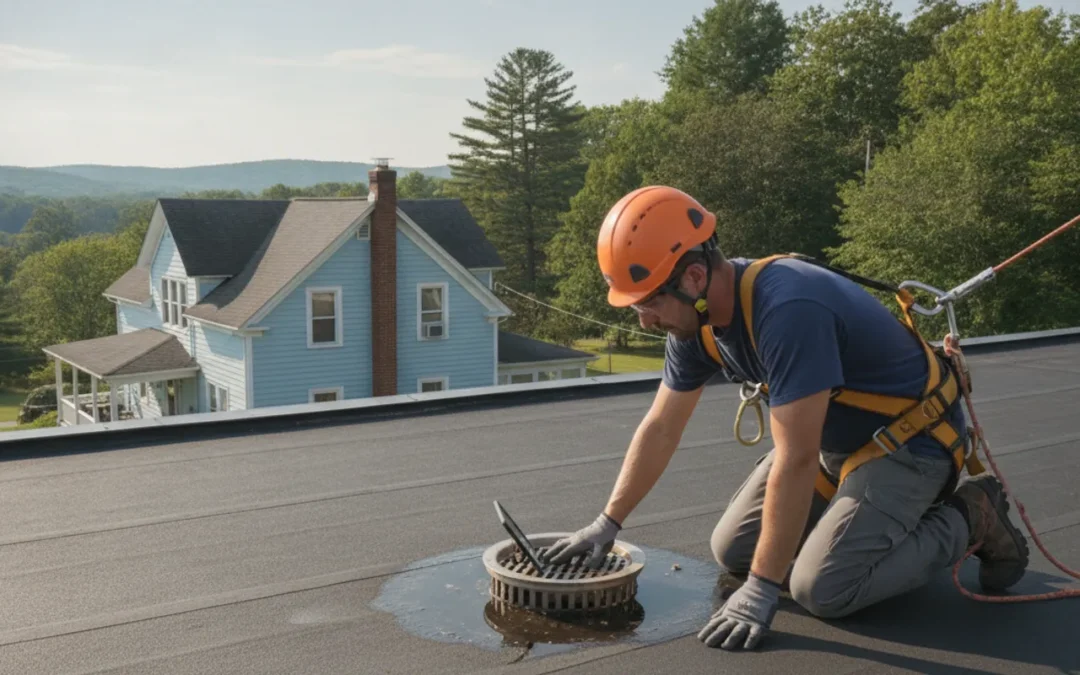
Rubber flat roof maintenance in Pennsylvania means checking the roof surface, drainage, edges, penetrations, and interior for changes so small problems can be addressed before they spread. Because flat and low-slope roofs hold water differently from steep roofs and face snow, freeze-thaw cycles, wind, and falling debris, owners should plan regular visual checks and arrange professional help when they see damage or persistent drainage concerns.
This guide is for homeowners and commercial property owners who want a practical maintenance routine, not a do-it-yourself repair manual. A roof may be described as rubber or flat, but systems and details can differ. Follow the roof records and product guidance for the specific installation, and have a qualified roofing professional assess conditions that are hard to see or unsafe to reach. For a broader look at roofing material decisions for Pennsylvania properties, start with MNM Roofing Professionals’ roofing resources, then use the maintenance steps below for the system already on your building.
Rubber flat roof maintenance Pennsylvania: What does it include?
Rubber and flat roof maintenance is a repeatable process of observing, documenting, and responding to changes in the roof and its drainage. It does not mean walking the roof every few weeks, applying a coating on a schedule, or trying to seal every mark. The right routine depends on the roof system, its age and condition, the building’s use, nearby trees, and the roof’s drainage layout.
A useful maintenance plan covers five areas:
- Surface: Look for new punctures, tears, open seams, loose or displaced material, blisters, wrinkles, or areas that look different from the surrounding roof.
- Drainage: Check that visible drains, scuppers, gutters, and downspouts are not blocked by leaves or other loose debris. Look for signs that water is not moving away as expected.
- Edges and transitions: Observe roof edges, parapets, flashing, and the places where the roof meets walls or other materials. Changes at these transitions deserve attention because water can enter at details, not only through the broad roof surface.
- Roof openings and equipment: Note the condition around vents, pipes, skylights, or other roof penetrations. Do not move equipment or disturb seals to investigate.
- Interior clues and records: Check ceilings and upper walls for new stains, bubbling paint, dampness, or musty odors. Record when and where you noticed a change, and keep inspection notes, photographs, and service records together.
These are observation points, not a substitute for a hands-on inspection. Some defects are difficult to identify from the ground or a doorway. If a roof surface is slick, steep at an edge, covered with snow or ice, or otherwise unsafe, stay off it. A professional can determine what inspection method is appropriate for the system and building.
Maintenance also means understanding what should not be done casually. Do not cut, puncture, pull, or patch roofing material based on a guess. Do not put a caustic cleaner, adhesive, sealant, or coating on the roof unless it is confirmed to be suitable for that specific system and location. Products that seem convenient can be incompatible with roof materials or can hide a condition that needs a proper repair. When in doubt, document the spot and ask for an assessment.
Identify the roof system before making a plan
“Rubber roof” is a common shorthand, but it does not provide enough information to choose a repair product or maintenance method. A property owner may not know whether the roof is a particular membrane, a coated system, or another low-slope assembly. Even two roofs that look similar from a distance may have different materials, seams, attachment methods, flashings, or manufacturer instructions. Do not identify a system by color or appearance alone.
Look for records before making assumptions. Useful sources may include the prior owner’s paperwork, a replacement or repair invoice, a warranty document, building maintenance files, or notes from a previous contractor. A label on a document may give the manufacturer and product family, while a work scope may describe the membrane or details installed. If paperwork is not available, tell the roofer that the system is unknown. That is more useful than guessing and buying a product based on a general description.
Keep any documents with a simple property file. Include installation dates if known, receipts, inspection notes, photographs, roof access rules, and written recommendations. If the building has more than one roof area, identify which section a record applies to. A low-slope addition, a main roof, and a covered entry might have different assemblies and drainage patterns. A clear file reduces the chance that a later observer mistakes one roof area for another.
When asking for maintenance advice, describe what you know and what you do not. For example: “The addition was replaced several years ago, but I do not have the product paperwork. A stain appeared near the back room after the last heavy rain.” That gives a professional a starting point without presenting an unverified diagnosis. Ask what evidence would help identify the roof and whether there are limitations to the inspection.
Set up a safe observation routine
A maintenance routine is useful only if it can be completed safely and consistently. Owners do not have to climb onto a roof to notice many changes. Choose a few repeatable viewpoints: the yard, a window with a clear view, the attic or upper floor if accessible, and the building interior below roof areas. Use the same general points when you revisit the property so that a new change is easier to compare with an earlier observation.
Make a short checklist for each visit rather than relying on memory. Note the date, recent weather, what you could see, and what you could not see. “No issue observed from ground” is more accurate than “roof inspected” when you did not access the roof. A photograph from the same safe angle can show whether a visible edge, downspout, or stain has changed. Avoid climbing a ladder to improve a photo or leaning out of a window.
Do not treat a routine observation as permission to clear every item. Loose leaves in an accessible ground-level gutter may be manageable under ordinary safety precautions; a blocked rooftop drain, heavy branch, damaged membrane, or snow-covered roof is different. If an action requires stepping onto the roof, handling a tool near the membrane, or reaching over an edge, stop and ask a professional. The objective is to identify a concern, not to take on roof work without proper training or access protection.
For commercial properties, decide who is authorized to report observations and who can arrange service. A tenant, maintenance employee, cleaning contractor, or equipment vendor may notice a change before the owner does. Give them a simple way to record the date, exact room or roof zone, and photographs taken from safe positions. Make clear that no one should enter a restricted area or move roof equipment to investigate.
What are common signs of wear?
A single mark does not always mean a roof is failing. The location, size, change over time, and relationship to drainage or a roof detail all matter. The practical question is whether the condition is new, getting worse, allowing water in, or affecting how the roof sheds water. Take a picture from a safe place and make a note rather than trying to test the surface yourself.
Surface changes
Cracks, cuts, punctures, open seams, lifted material, or an area that appears displaced should be assessed. Damage can result from foot traffic, tools, branches, or other activity on the roof. Do not assume a small opening is harmless, and do not cover it with whatever patch material is on hand. A repair has to suit the roof system and the location of the problem.
Blisters, wrinkles, and bubbles can have more than one cause. Their appearance alone does not establish what is happening beneath the surface. Avoid cutting or pressing them. Photograph the area if it is visible from a safe vantage point, then ask a roofing professional whether an inspection is appropriate.
Look for change, not just a particular appearance. A seam that has always looked slightly different may not be a new issue; a seam that appears to be lifting or opening deserves attention. A new wrinkle after rooftop work should be documented with the date and the work that occurred. If you have older photographs, compare only what is visible and avoid interpreting an image as a complete diagnosis. A professional should assess the actual condition before anyone decides whether a repair is needed.
Water that does not drain as expected
After rain, water may remain in a low area for some time, but repeated or persistent pooling, a drain that appears blocked, or water backing up at an edge deserves attention. There is no single visual rule that lets an owner diagnose the roof from a photograph alone. Roof design, drainage details, weather, and the condition of the system all affect what a professional should evaluate.
Keep drains and accessible ground-level outlets clear of loose leaves when it is safe to do so. Never reach into a roof drain, remove a grate, or use a tool that could puncture the membrane unless you know the detail is designed for that work. If water is ponding or entering the building, contact a roofing professional rather than trying to redirect it with improvised materials.
Observe the whole path of the water where possible. On the exterior, note whether downspouts discharge where expected, whether an outlet seems blocked, or whether water marks have appeared below a roof edge. Inside, note whether a ceiling stain or damp area appears near a drain, wall, or penetration, but do not assume that the visible interior spot is directly below the source. Water can move within a roof assembly or along building components before it becomes noticeable.
Record the weather context. A puddle seen immediately after a storm and a recurring area observed under different conditions are not the same observation. If you can safely view the roof from inside a building or a ground-level location, note when the water was present and whether it later disappeared. Do not delay contacting a roofer if water is entering just because you want to observe another rain event.
Changes at flashing, edges, and penetrations
Look for a gap, lifted edge, loose-looking flashing, displaced counterflashing, or a change where a pipe or other penetration meets the roof. These areas are easy to overlook from inside the building, yet they form important transitions. Do not pry at flashing or add caulk to a joint without knowing the correct repair approach. A quick application can make a later inspection harder and may not address the source of water.
Roof details deserve careful observation because the roof is not one uninterrupted sheet. It meets walls, curbs, drains, vents, and edges, and each transition has to work with the surrounding materials. A change in one small location can matter even when the broad roof surface appears unchanged. When you report a concern, describe the closest feature you can identify, such as “near the vent above the kitchen” or “at the back parapet,” rather than calling it a specific failure.
Do not tug on a pipe boot, lift an edge, push a flashing panel, or remove a cover to see what lies underneath. Apart from the risk of injury, that action can change the condition or cause damage. If a repair technician or equipment contractor has recently worked near a penetration, record who visited and when. The information can help a professional understand the sequence of events without assigning a cause prematurely.
Indoor signs of a possible leak
A new ceiling stain, peeling or bubbling finish, damp insulation, dripping, or a musty smell can be a reason to investigate. Note the room, the location, and when the sign appeared. If it is safe, move belongings away from active water and use a container to limit damage indoors. Do not climb onto a wet roof to find the source. Water can travel from the point of entry before it becomes visible inside, so the ceiling stain may not sit directly below the roof opening.
Take a photograph that includes context, such as the whole ceiling area and a closer view of the stain, without standing beneath a bulging or sagging surface. Mark the date in your notes rather than writing on a wet ceiling. If water is active, note whether it is dripping, spreading, or stopping, and whether the leak follows a particular weather event. Share that information with the roofer. A stain that looks dry today can still be a useful clue about a previous event.
Protect people before property. If a ceiling is sagging, keep people out of the area and do not poke or press it. Stay away from wet electrical fixtures and do not touch switches or equipment in a wet area. Move furnishings only if you can do so safely. If water is flowing into the building or creating an immediate hazard, seek appropriate emergency assistance in addition to arranging roofing help.
Debris, branches, and signs of traffic
Leaves, seed pods, branches, and other debris can interfere with drainage or conceal a change in the roof surface. A new scuff, puncture, or displaced material may also follow maintenance work or rooftop access. Keep a record of contractors or building work that involved roof access, and ask workers to report accidental damage promptly. Clear loose debris only from a safe, accessible location without dragging tools or containers across the roof.
Pay attention to events that could explain when a change began: a windstorm, nearby tree work, a service visit, a new rooftop unit, or a worker carrying materials across the roof. This timeline does not prove what caused the condition. It simply gives the professional information that may guide an inspection. For a commercial building, coordinate roof access through one responsible contact so that different vendors do not enter the area without the owner knowing.
Do not store spare materials, ladders, seasonal decorations, or household items on a low-slope roof unless the roof and building rules specifically allow it. Items can obstruct drains, rub against the membrane, or make it harder to notice a developing concern. If equipment needs regular service, ask the building manager to document the visit and report any change observed while the work is being done.
What seasonal checks make sense for Pennsylvania properties?
Seasonal checks help owners notice changes after weather shifts and before a small concern becomes harder to manage. The schedule should fit the building and the roof system rather than follow a one-size-fits-all calendar. A homeowner may be able to observe from the ground, attic, or upper-floor windows. A commercial owner may also need to coordinate with facility staff and anyone authorized to access the roof.
Think of a seasonal check as a set of observations prompted by changing conditions, not as a promise that every part of the roof has been inspected. Pair exterior observations with an interior check and a quick review of recent work. If a concern comes up, record it and decide whether it is urgent, whether it can be safely observed from a distance, or whether a professional should assess it. Do not wait for a particular season if a leak or visible damage appears.
After winter and during spring cleanup
Once conditions are safe, look for changes that may have developed during cold weather: damage near edges, new interior stains, displaced debris, or drainage trouble. Freeze-thaw weather can make an existing concern more noticeable, but the cause should not be guessed from timing alone. Check whether downspouts and other visible outlets can carry water away from the building, and note any new overflow or staining on exterior walls.
Snow and ice make roof access especially hazardous. Do not climb onto an icy roof or use a shovel, pick, or similar tool to break ice off a membrane. If snow or ice is creating a concern, seek guidance from a qualified professional who can consider the roof and safe work practices. Avoid directing salt, heat, or chemicals at the roof unless the roofing system’s approved guidance specifically allows it.
As snow melts, watch from safe locations for interior moisture, new ceiling marks, or water appearing at a wall or doorway. Check the attic only if it is designed for safe access and you can avoid stepping on ceiling materials, insulation, wiring, or other hazards. Do not enter an attic with standing water, damaged wiring, or signs of structural distress. A brief visual observation is not a reason to handle insulation or move building materials.
Spring cleanup is also a good time to review the roof file. Add any winter observations, note whether a previously reported condition was addressed, and keep the written scope or invoice with the rest of the records. If you are unsure whether a concern was repaired or only temporarily addressed, ask the contractor who performed the work or arrange a new assessment. A clear question is better than assuming that an old stain means the issue is resolved or still active.
During the growing season
Check for branches overhanging the roof, debris collecting near drains, and changes around rooftop equipment or service areas. If trees drop leaves, blossoms, or twigs onto the building, pay particular attention to the drainage points after those periods. Do not trim branches from a roof or work near electrical lines as part of a roof check.
Warm weather can bring more roof access for air-conditioning service, construction, painting, or other work. Tell vendors where access is allowed and ask them to report any accidental impact or change they notice. Before work begins, take a safe photograph of the relevant area if you can. Afterward, record the date and whether the work involved carrying equipment across a roof, opening a curb, or reaching a roof penetration. This simple before-and-after record can make later conversations more specific.
For a commercial building, review roof access and traffic. Ask staff and service contractors not to store materials on the roof, drag equipment, or step over sensitive details. If regular access is necessary, confirm that the building has an appropriate access plan and that any walk paths or protective measures are suited to the roof. Do not assume that a roof is designed for storage or frequent foot traffic.
For a home, consider the same principle when arranging satellite, HVAC, solar, or other work: agree in advance who will access the roof and how the property owner will be told if a concern is discovered. A service person may not be a roofing professional, so a report should be treated as an observation rather than a final diagnosis. Ask for the location and a photograph taken from a safe position, then contact a roofer if the report suggests damage.
Before and after fall weather
Remove leaves from ground-level gutters and downspout openings where you can do so safely. Observe roof drains and scuppers only from an approved, safe vantage point. After a windy storm, look from the ground for fallen branches, loose material, or a new change to the building exterior. If you suspect roof damage, avoid climbing up to confirm it.
Before winter, check that any known maintenance concerns have been recorded and discussed with a professional. Do not wait for the first freeze to report an active leak, blocked drainage, or visible damage. A timely assessment gives the owner a chance to understand the condition and options before weather makes access more difficult.
Review the path water takes around the building. Check visible gutters, downspouts, and outlets for leaves that can be removed safely from the ground or another stable location. Note any places where water has begun to stain siding or collect near an entrance. A gutter or downspout concern may be separate from the roof membrane, but water management around the building is connected. If you need help evaluating exterior drainage, MNM’s gutter and downspout services provide a relevant starting point.
Make a short winter-readiness note for the property rather than attempting last-minute roof work. List known leaks, previous repairs, areas that should not be accessed, the contact person for service, and the location of maintenance records. For a commercial property, share the plan with the staff member who handles building access. This preparation helps people respond consistently if they notice a new stain or drainage change during cold weather.
After a major storm or building work
Use a ground-level visual check after severe weather, nearby tree damage, or work that involved roof access. Look for new debris, displaced materials visible from below, water stains, or a change in drainage. Photograph what can be seen safely, and note the date and weather. Do not treat a lack of visible damage from the ground as proof that the roof is unaffected.
For more guidance on deciding what to do after a storm, visit MNM Roofing’s roofing resource page. If you believe a storm caused damage, document observations and contact a roofing professional. A contractor can assess visible roof conditions; any insurance decision is made by the insurer under the policy. Do not assume that a particular repair or replacement will be covered.
After construction or service work, compare the areas you can safely observe with your earlier notes. Report a fresh ceiling stain, visible debris, damaged exterior trim, or a worker’s report of accidental impact. Include who performed the work and which areas they accessed. Do not assign blame based only on timing; instead, preserve the information and request an assessment where appropriate.
When there has been a storm, avoid treating temporary weather conditions as a reason to take unsafe action. Do not go outside during dangerous winds, handle a fallen electrical line, climb a ladder on wet ground, or walk under an unstable tree limb to photograph the roof. Take notes when it is safe. If a tree or other object has struck the building, keep clear of areas that could be unstable and arrange appropriate help.
How can property owners make a useful maintenance log?
A simple log turns isolated observations into a record that can be discussed with a roofing professional. It does not need special software. A notebook, spreadsheet, or folder of dated photographs can work if the information is organized and kept with the property records. The most useful notes distinguish what you saw from what you think it might mean.
For each entry, include:
- Date and conditions: Record the day you noticed the issue and, when relevant, whether it followed rain, wind, snowmelt, roof work, or equipment service.
- Exact location: Name the room, building side, roof section, or nearby feature. Use a simple sketch or labeled building plan if several areas look alike.
- Visible evidence: Describe a stain, drip, debris, blocked-looking outlet, displaced material, or other observation without calling it a confirmed cause.
- Changes over time: Note whether the mark became larger, dried, returned after rain, or stayed the same. Do not put yourself at risk to collect repeat observations.
- People and work involved: Record service visits, construction, roof access, or prior repairs that may help establish a timeline.
- Follow-up: Keep the name of the person contacted, date of the assessment, written recommendation, and any work scope or invoice.
Use neutral language. “Water stain about the size of a dinner plate in the rear office, first noticed the morning after rain” is more useful than “the roof drain failed” when no one has inspected the drain. The distinction matters because a visible symptom can have multiple possible explanations. A roofer can test or inspect the relevant areas using an appropriate method; your log helps communicate when and where to begin.
For photographs, capture one wider view and one closer view only when both can be taken safely. Keep the originals and add a date in the file name or a separate note. Avoid filters or edits that change the appearance. If you photograph an interior mark, include a nearby wall or fixture to show its location. If a picture does not show the roof itself, label it as an interior symptom rather than a roof condition.
For a multi-tenant or multi-building property, use consistent labels. A shared log might identify each building by address or letter, then identify a room or roof area. Give tenants a simple reporting method and tell them not to enter a roof-access area. The owner or facility manager can combine reports, look for repeated patterns, and arrange professional follow-up without asking occupants to investigate the roof themselves.
Rubber flat roof maintenance Pennsylvania: When does it become a repair question?
Maintenance becomes a repair question when you see damage, recurring drainage problems, a new leak, or a condition that keeps changing. A repair question is not the same as a confirmed diagnosis: an owner’s job is to describe the symptoms and arrange an appropriate assessment, not to determine the cause by opening up the roof.
Contact a roofing professional promptly when you notice:
- Active water entering the building, or a new stain that grows after rain.
- A visible cut, puncture, open seam, loose section, or damaged roof edge.
- Repeated pooling or overflow, particularly when it occurs with indoor moisture.
- Damage near a roof drain, scupper, wall transition, or penetration.
- Material displaced by wind, impact, or roof traffic.
- A condition that returns after a previous repair or becomes more noticeable over time.
- Uncertainty about whether it is safe to access or clear a part of the roof.
If water is actively entering, prioritize safety inside the building. Keep people away from a sagging ceiling or any area where electrical fixtures are wet. Protect belongings only when it is safe, and arrange professional help. Avoid placing weight on a wet or softened ceiling and do not go onto the roof during a storm or icy conditions.
Whether to repair, maintain, or consider replacement depends on the specific roof’s condition and service history. A single symptom cannot answer that question. Ask the professional to explain what they observed, where it is located, whether the concern is isolated or widespread, and what next steps are recommended. If work is proposed, request a written scope that describes the area, the work, and any relevant assumptions. Do not rely on a vague instruction to “seal it” without understanding what is being addressed.
Owners of homes can learn more about MNM’s residential roofing services. Owners of stores, offices, and other buildings can review the company’s commercial roofing services. Those pages provide a service starting point; an assessment is needed to determine what work a particular roof requires.
How to think about urgency
Not every roof observation calls for the same response. Active water, a ceiling that is sagging, or an immediate safety concern is different from a small exterior mark seen from the ground. Use the following as a way to organize communication, not as a substitute for professional judgment:
- Immediate safety issue: Keep people away from an unstable ceiling, wet electrical area, fallen line, or unsafe roof access. Seek appropriate emergency assistance where needed and contact a roofing professional when it is safe.
- Active leak or visible damage: Report it promptly. Protect belongings only if doing so is safe, record the location and timing, and avoid climbing onto the roof.
- Recurring or worsening concern: Share the maintenance log and arrange an assessment. Repeated symptoms deserve attention even if they temporarily dry out.
- Uncertain observation without active symptoms: Save a photograph and note the location. Ask a qualified roofer whether the condition warrants an inspection, especially if it is near a drain, edge, or penetration.
Do not use this list to decide that a condition can safely wait. Weather, building use, and the location of a problem all matter. If you are unsure whether people or property are at risk, err on the side of keeping clear and seeking qualified help. When reporting an issue, mention whether water is actively entering and whether any ceiling or electrical area appears unsafe so the recipient can understand the situation.
Repair, continued maintenance, or replacement?
Owners often want a quick answer about whether one visible problem means the whole roof should be replaced. The observation alone rarely answers that. A professional assessment can help distinguish an isolated repair need from a broader condition that warrants additional evaluation. Relevant context can include the roof’s known age, past repair history, the spread and location of symptoms, drainage performance, the condition of details, and whether the existing system can be reliably identified.
Ask the roofer to explain the basis for a recommendation in plain language. Which area was observed? What condition was found? Is there evidence of moisture inside the building? Is the suggested work limited to a location, or does the professional recommend further investigation? What is not included in the proposed scope? These questions help an owner understand the decision without assuming that a particular option is right for every roof.
If a repair is proposed, ask how the work fits the roof system and what additional observation or follow-up is appropriate. If broader work is discussed, request that the estimate describe the areas involved, materials or details to be addressed, and any conditions that may affect the scope. Compare the written work being proposed, not merely the labels “repair” and “replacement.” A clear scope makes it easier to ask a follow-up question before authorizing work.
Do not use an online image or a neighbor’s experience as a diagnosis for your roof. Roof age and appearance do not establish the condition of concealed materials or the source of a leak. A professional who has assessed the building can explain what was actually observed and what remains uncertain. If you need a service discussion, MNM’s estimate and contact page is the direct place to ask about next steps.
How should you plan a professional assessment?
A clear record helps a roofing professional understand what you have noticed and plan the visit. Before making an appointment, gather what is readily available; do not delay a call to search for every document if water is actively entering.
- Describe the concern: Note whether you saw a stain, dripping, debris, pooling, a visible surface change, or something else. Include when it first appeared and whether it has changed.
- Record the location: Identify the room or area of the building and, if you can do so without risk, the nearest visible roof feature. A simple sketch can help. Do not climb onto the roof to get a closer photograph.
- Take safe photographs: Photograph indoor staining and exterior conditions from a stable, safe location. Include a wider view for context and a closer view only when it is safely accessible. Do not use a ladder or lean out of a window to capture an image.
- Gather roof history: Share prior repair or replacement records, known roof-system information, and dates of recent work if you have them. If you do not know the material or installation history, say so rather than guessing.
- Explain building use: Mention roof access, rooftop equipment, regular service visits, or any construction that may have affected the roof. For a commercial property, identify the person who can coordinate safe access.
- Ask about findings and next steps: Request an explanation of the observed condition, what should be addressed, and whether more inspection is needed. Ask for a written estimate or scope when work is recommended.
During the assessment, ask how the proposed work relates to the roof system and the location of the concern. If a temporary measure is recommended, ask what it is intended to do and whether further work is needed. Request clarification on what the estimate includes and excludes. These questions help you compare scopes based on the work described, rather than on a short label such as “repair.”
Before the visit, tell the roofer about access limitations, locked areas, tenants, pets, or equipment that could affect the assessment. For a commercial property, arrange access with the person responsible for the building and make sure the professional knows which roof areas are relevant. Do not ask a tenant or employee to unlock a roof hatch or provide access if they are not authorized to do so. A safe, coordinated visit is more useful than an unplanned attempt to reach a roof.
Prepare a few questions in advance. You might ask what parts of the roof were observable, whether the drainage route appeared clear, what details were checked, and what could not be confirmed. Ask whether the recommendation is based on a visible condition or whether further evaluation would be needed. If there are multiple roof sections, confirm which ones were included so that a recommendation for one area is not mistakenly applied to the whole building.
After the assessment, keep the written notes, estimate, photographs, and any work authorization together. If you approve work, record when it was completed and ask what documentation will be provided. If the recommended work is not performed immediately, note why and what signs should prompt a follow-up. This creates a useful maintenance history for the next owner, facility manager, or roofing professional.
For a homeowner, it can help to have one person gather the records and describe the problem so details are not lost between calls. For a business, identify a single contact who can relay tenant reports and authorize building access. Share facts rather than assumptions: the date, weather, location, visible evidence, and any related service visit. A concise account often makes the first conversation more productive.
For owners considering an installation, replacement, or a different roofing material, the appropriate options depend on the building and its needs. A flat or low-slope roof should be evaluated as a complete system, including drainage and transitions, rather than by focusing on the surface material alone. MNM Roofing Professionals serves residential and commercial customers in Northeast Pennsylvania, including the Poconos, Luzerne County, and the Lehigh Valley. Its crews are in-house, and the owner oversees estimates and works alongside crews. Learn more about the company through its company overview.
Contact MNM Roofing Today for help reviewing a rubber or flat roof concern in Pennsylvania.
Frequently asked questions
How often should I inspect a rubber or flat roof?
There is no single inspection interval that fits every roof. Consider the roof’s age and condition, drainage, nearby trees, building use, prior problems, and the manufacturer’s guidance. Make safe visual observations throughout the year and after significant weather or roof work. Arrange a professional inspection when you see a change, have recurring concerns, or are unsure whether an area is safe.
Can I walk on a rubber flat roof to check it?
Do not assume the roof is safe for foot traffic. Access may be dangerous, and walking or dragging tools across a roof can damage the surface or details. Stay off a roof that is wet, icy, snow-covered, or otherwise unsafe. Ask a qualified professional to determine whether and how it should be accessed.
Is standing water always a sign that a flat roof needs repair?
Not necessarily. Water observed after rain does not, by itself, identify the cause or establish what work is needed. Repeated or persistent pooling, blocked-looking drainage, overflow, or water accompanied by an interior leak should be documented and professionally assessed. Do not try to diagnose the roof or change its drainage with improvised materials.
Can I patch a small tear or add sealant myself?
A patch or sealant must be appropriate for the roof system and the specific location. Using an incompatible product or applying it over an unassessed condition can complicate repair. Unless the correct method and materials are confirmed for that roof, photograph the concern safely and ask a roofing professional to assess it.
What should I do if I find a leak during winter?
Protect people first. Keep clear of a sagging ceiling or wet electrical fixtures, move belongings only if safe, and contact a roofing professional. Do not climb onto an icy or snow-covered roof or try to remove ice with tools or chemicals. Record the location and timing of the leak from inside, and share those details when requesting help.
What information should I share when requesting an assessment?
Share the building address, the room or roof area where you noticed the concern, when it began, whether water is active, and any recent weather or roof work that may be relevant. Mention any access restrictions and provide safe photographs or roof records if available. Do not delay a call about active water while gathering paperwork, and do not guess at the source if it has not been inspected.
Can a roof look fine from the ground and still need attention?
Yes. A ground-level view cannot show every seam, drain, flashing detail, or concealed condition. A lack of visible damage from below is not proof that every roof area is unaffected. If you have a recurring leak, interior stain, or other reason for concern, share the symptoms and arrange an appropriate professional assessment.
Ready to plan your roof assessment?
Regular observation, clear records, and prompt attention to changes can help property owners make informed maintenance decisions. If your rubber or flat roof has a leak, visible damage, or a drainage concern, or you would like a professional to assess its condition, contact MNM Roofing Professionals to discuss the property and next steps.
Keep roof access safe, follow guidance for the specific roof system, and seek a professional assessment whenever a condition is unclear or worsening.