


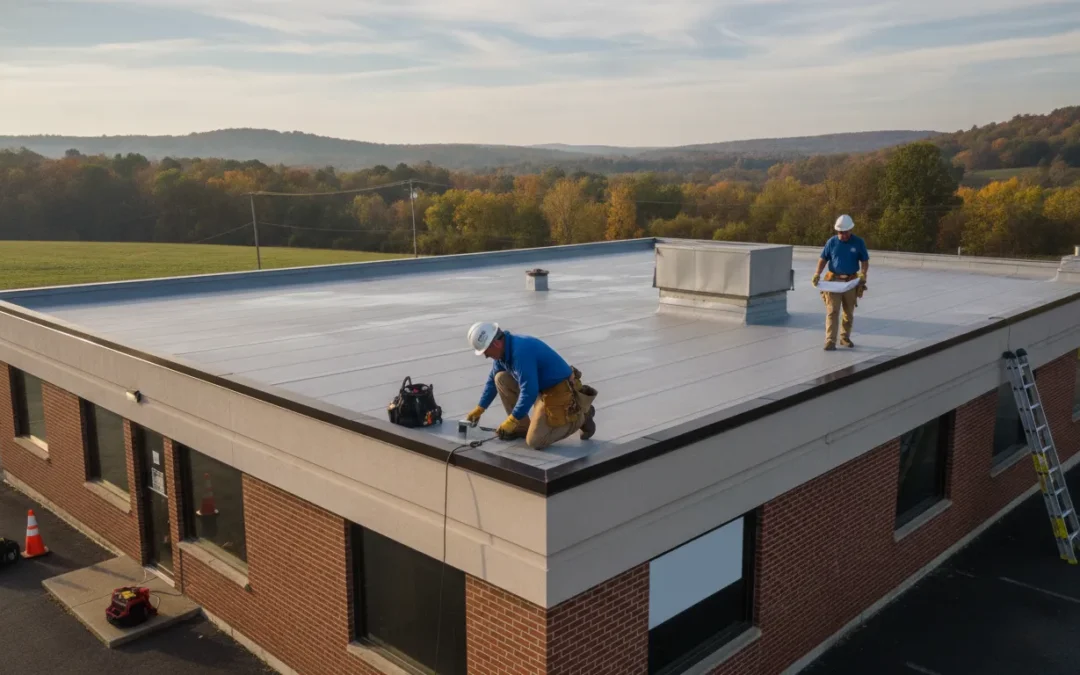
A commercial roof rarely fails at the first visible leak. Small drainage problems, damaged flashing, aging seams, and deferred inspections can become disruptive decisions when no one has a clear record of what changed and when.
Ready to discuss your property? Call (570) 793-5715 or request a free estimate from MNM Roofing Professionals.
A commercial roof maintenance pennsylvania guide should help owners and property managers organize inspections, document roof conditions, account for seasonal risks, and decide when routine observation needs to become professional repair or replacement planning. The right approach is based on the building, roof system, drainage, rooftop equipment, and available records, not a one-size-fits-all calendar.
Use this framework to build a practical plan for your Pennsylvania property, then request a free estimate when the condition or scope calls for qualified support. Start by defining what your maintenance plan needs to track and protect.
What Should a Commercial Roof Maintenance Pennsylvania Guide Help You Plan?
A useful plan gives a property owner or manager a repeatable way to monitor the roof, document conditions, and decide when a concern needs professional evaluation. It is not simply a list of repairs. The goal is to keep the roofing assembly watertight and allow water to drain freely. The right maintenance approach depends on the roof assembly, its age, and the quality of its components. Federal facilities guidance states these objectives directly, and Philadelphia Water Department guidance similarly connects periodic inspections with decisions about whether repair or replacement may be necessary.
For Pennsylvania commercial properties, planning should account for the building’s use, roof access, drainage design, rooftop equipment, and the consequences of a leak inside occupied or inventory-sensitive areas. Start by identifying who will observe the roof, what will be recorded, and how findings will be reviewed. A maintenance plan can include inspection dates, photographs, notes about recurring trouble spots, drainage observations, and a clear path for escalating conditions that do not resolve through routine upkeep.
Maintenance planning is different from a repair guide
A repair guide answers what to do after damage, an active leak, or a failed component has been identified. Maintenance planning comes earlier. It establishes the observation and documentation habits that can reveal deterioration before it becomes an urgent disruption. It should not attempt to reproduce a complete checklist or provide a repair procedure for every roof system. Instead, it helps teams prepare useful information for the next decision.
Use the service page for contractor context
The planning guide also has a different purpose from a commercial service page. A service page explains available roofing work and how to contact a contractor. Once your records show that an assessment, repair, replacement, or other project may be appropriate, you can review MNM’s commercial roofing services in Pennsylvania. The guide remains informational, while that page provides service context.
In short, plan around condition, drainage, records, and decision points. That framework keeps routine maintenance separate from repair instructions while making it easier to recognize when qualified roofing support is appropriate.
Start With the Roof System, Building Use, and Existing Records
A useful maintenance baseline begins with knowing what is on the building and how the property operates. Record the roof-system type, approximate age, and major component materials before setting inspection tasks. Maintenance needs can vary with the assembly type, age, and quality of its components, so a plan built from those details is more useful than a generic calendar. Philadelphia Water Department guidance makes the same connection when discussing roof assembly and waterproofing membrane maintenance.
Next, document the building use and anything that affects access or exposure. A warehouse, office, retail property, apartment building, and manufacturing facility may have different rooftop traffic, interior sensitivities, and operating schedules. Note rooftop equipment such as HVAC units, exhaust systems, vents, skylights, access paths, and other penetrations. These features should be part of the baseline, not treated as unrelated items during a later inspection.
Build a map of roof components and conditions
Divide the roof into identifiable areas and record the condition of the surface and its features. The University of Minnesota commercial roof checklist includes debris, drainage, physical damage, punctures, seam failures, blisters, ponding, pitch pans, fasteners, unadhered areas, bridging, and metal corrosion among its inspection points. It also calls attention to penetrations, gutters, drains, and vents. This gives a property manager a practical vocabulary for describing what is present without assuming that every issue has the same cause or urgency.
Pay particular attention to seals and flashing around roof penetrations and transitions. These components occupy a small part of the roof. They deserve careful review because leaks often occur when seals or flashing fail, according to a building research digest from the National Research Council of Canada.
Use photos and records to make changes visible
Take baseline photos from consistent locations, label the roof area shown, and keep copies with inspection notes. Record observed deficiencies, completed work, remaining maintenance, affected locations, and planned follow-up. A checklist can help prevent items from being missed and create a permanent performance record that supports future comparisons. The University of Minnesota checklist specifically recommends documenting deficiencies, locations, photographs, and remaining repairs or maintenance.
Finally, decide who will carry out routine observations and who will handle technical assessments. An owner can use an in-house program when trained personnel have the mandate, time, and resources to perform it. Another option is a qualified inspection agency. The important point is to define responsibility clearly, preserve the records, and use the baseline to guide the next inspection rather than starting over each season.
How Often Should a Commercial Roof Be Inspected?
There is no single inspection schedule that fits every commercial roof in Pennsylvania. A practical cadence should reflect the roof system, its age and condition, the building’s use, rooftop equipment, drainage demands, and the consequences of a leak. The goal is to identify developing problems while they are still manageable, not to wait for water intrusion to interrupt operations.
Build a baseline, then adjust the schedule
Start with a documented baseline inspection. Record the condition of the roof surface, seams, flashings, penetrations, drains, gutters, and visible interior areas. Take dated photographs and note existing deficiencies. The baseline gives the property owner something to compare against during later visits and helps distinguish new damage from older conditions.
From there, many owners plan routine reviews at least seasonally or on another recurring schedule appropriate to the property. An EPA periodic-inspection checklist places roof condition and leak checks within a three-month building-envelope inspection interval. But that checklist is a planning reference, not a universal requirement for every Pennsylvania property. Philadelphia guidance for blue-roof systems recommends monthly inspections during the first year after installation to establish an ongoing maintenance frequency. That example applies to a specific system and should not be treated as a general commercial-roof rule.
Use risk and events to refine the cadence
Some Pennsylvania roofing guidance uses twice-yearly inspections, often timed before and after winter, as a practical example. Other programs may need more frequent attention when a roof is older, has a history of leaks, supports busy rooftop equipment, or has drainage concerns. A qualified roofing professional can help match the schedule to the assembly and observed conditions rather than relying on a calendar alone.
Schedule an additional review after a major storm or another event that could affect the roof. Look for displaced or damaged components, punctures, blocked drains, new ponding, damaged flashing, and signs of interior moisture. If access is unsafe or the condition is uncertain, do not send untrained personnel onto the roof.
Keep the inspection record useful
Each inspection should identify the date, areas reviewed, photographs, observed deficiencies, recommended action, and target timing. Maintain records of inspections and maintenance activity so trends are visible over time. A recurring leak, worsening ponding, or repeated damage may justify a focused assessment instead of simply adding another routine visit. For properties in Luzerne County, MNM can provide commercial roof inspections in Luzerne County as part of a broader maintenance planning process.
What Should a Commercial Roof Inspection Look For?
A useful inspection is more than a quick search for an active leak. It should document the condition of the roof surface, the way water moves off the building, the points where equipment and materials interrupt the roofing system, and signs that moisture is affecting the interior. The goal is to identify conditions that could interfere with a watertight assembly or free drainage, then record enough detail to plan appropriate maintenance.
Roof surface
What to look for: Debris, physical damage, punctures, seam failures, blisters, ponding water, unadhered areas, bridging, fastener issues, and metal corrosion.
Why it matters: These conditions can weaken the roof assembly or allow water to move below the visible surface. The University of Minnesota roof inspection checklist includes these items among its roof-surface checks.
Drainage
What to look for: Blocked or damaged drains, gutters, downspouts, outlet screens, secondary drainage, overflows, sediment, and areas where water remains for extended periods.
Why it matters: Drainage problems can leave excess water on the roof and increase the chance of leaks. Clogged, broken, misaligned, or leaking drainage components should be documented for cleaning, repair, or replacement as appropriate. See MNM’s information on commercial roof drainage and gutters.
Penetrations and rooftop equipment
What to look for: Pitch pans, vents, flashing, seals, fasteners, equipment curbs, and other places where pipes or equipment pass through or sit on the roof.
Why it matters: Small areas around penetrations and flashing deserve careful attention. Building research guidance notes that many leaks occur when seals and flashing fail, even though they cover relatively little roof area.
Interior and building envelope
What to look for: Ceiling stains, damp insulation, interior leaks, moisture near roof penetrations, and visible concerns with the supporting structure or envelope.
Why it matters: Interior evidence can reveal water entry that is not obvious from the roof surface. Inspection categories should include general roof conditions, the structure, the roof surface, and roof features rather than focusing on one symptom alone.
Photographs, locations, and a clear description of each deficiency make the inspection useful after the crew leaves. Compare findings with earlier records when available, and escalate persistent leaks or deteriorated components for a qualified assessment instead of treating them as routine debris.
Seasonal Maintenance Priorities for Pennsylvania Commercial Buildings
Seasonal planning helps commercial property teams address changing roof conditions before a small concern affects operations. The right priorities depend on the roof assembly, drainage design, rooftop equipment, and recent weather. Use the following as a planning framework, not a mandatory schedule for every Pennsylvania building.
Spring: Clear debris and check drainage
After winter, look for branches, leaves, sediment, displaced materials, and damage around drains, gutters, downspouts, and overflow paths. Debris can restrict drainage and leave water standing longer than intended. Philadelphia Water Department guidance specifically identifies debris removal around outlets and storage areas as a maintenance need, and recommends checking for leaks and clearing secondary drainage and overflows as needed. Review the roof surface and interior areas for signs that moisture entered the building during the colder months.
Summer: Watch ponding, seams, and rooftop activity
Summer maintenance is a useful opportunity to document roof conditions while planning access around HVAC service, construction, or other rooftop work. Pay attention to ponding that remains after precipitation, slow drainage, loose or damaged components, and areas around penetrations. Prolonged ponding or drainage that is too slow can indicate a performance problem, so record the location and duration rather than assuming it is harmless. Keep inspection notes and photos with the building’s roof records.
Fall: Prepare for leaves and storm-related damage
Before leaf fall and severe weather, confirm that drains, gutters, and downspouts are open and that access points can be reached safely. Remove accumulated debris according to the building’s maintenance plan, and photograph existing conditions before major work or storms when practical. After a significant storm, document visible damage, displaced materials, new leaks, and changes in drainage. Storm damage inspection guidance can help organize the next steps without treating every observation as an emergency.
Winter: Address ice carefully and monitor freeze-thaw effects
Ice around outlets and overflows can interfere with drainage and should be addressed as needed during winter. Avoid improvised methods that could damage a membrane, flashing, or drainage component. Freeze-thaw cycles can stress roofing membranes and seams, so compare winter observations with earlier photos and records. If ponding, leaks, blocked drainage, or damaged components persist, have the condition evaluated by a qualified roofing professional before deciding whether maintenance, repair, or replacement is appropriate.
When Does Maintenance Become a Repair or Replacement Decision?
Maintenance is meant to preserve performance, but it also provides the evidence needed to decide when routine attention is no longer enough. A periodic inspection can show whether a roof assembly or waterproofing membrane needs repair or replacement. The right decision depends on the roof system, its age, and the quality and condition of its components, not on a universal age cutoff.
Look for patterns, not one isolated observation
A single piece of debris or a minor maintenance item may be handled as part of normal upkeep. Escalation becomes more appropriate when the same issue returns, affects drainage, or is associated with water entering the building. Recurring leaks deserve documentation and investigation, even when the visible interior stain appears small. The leak source may be a failed seal, flashing, penetration, membrane area, or another roof feature rather than the point where water first appears.
Seals and flashing cover relatively little roof area, but they are especially important because many leaks occur when these details fail. They should be inspected carefully and maintained as part of the roof system, rather than treated as secondary trim. See the building research guidance on roof seals and flashing for the basis of this inspection priority.
Use watertightness and drainage as decision tests
A practical maintenance objective is to keep the roof watertight. Prevent water from reaching the building interior or insulation, and allow water to drain freely from the roof surface. Damaged, deteriorated, or missing roofing components may therefore require repair or replacement to restore a watertight seal. Broken or leaking drains, gutters, and downspouts can also move beyond cleaning and require corrective work.
Persistent ponding, slow drainage, repeated component damage, or leaks that return after prior work are signals to move from observation to a qualified assessment. They do not, by themselves, prove that the entire roof must be replaced. A professional should evaluate the roof assembly, affected details, drainage, prior repairs, and the scope of deterioration before recommending localized repair, broader rehabilitation, or replacement. Guidance for facilities maintenance similarly calls for inspection, maintenance, and repair practices that keep roofing systems watertight and draining properly: federal roofing maintenance requirements.
Plan the next action from documented evidence
Keep inspection notes, photographs, leak locations, completed work, and unresolved defects together. A documented pattern helps a property owner compare recurring repairs with the roof’s overall condition and plan work before water intrusion disrupts operations. If problems persist after routine maintenance, seek a qualified roofing assessment rather than relying on a generic lifespan or cost assumption. For additional storm-related planning, review MNM’s storm damage inspection guidance.
How to Document Work and Choose Roofing Support
A good maintenance plan becomes more useful when the property team can show what was inspected, what changed, and what still needs attention. Use this sequence to turn roof observations into organized decisions without treating a general planning guide as a substitute for a qualified assessment.
- Gather the roof records. Start with the roof system type, available installation or repair history, previous inspection notes, and known leak or drainage concerns. Record the building areas covered, the date of each visit, and the person who completed it. A documented history helps the next reviewer understand whether a condition is new, recurring, or already addressed.
- Photograph and locate conditions. Take clear, before-and-after photos of visible deficiencies, then identify each image by roof area or a simple site sketch. Note the condition of surfaces, seams, flashing, penetrations, drains, gutters, and downspouts when relevant. The University of Minnesota checklist recommends recording deficiencies, locations, photographs, and remaining maintenance items, which gives property managers a practical model for consistent documentation: inspection documentation guidance.
- Separate completed work from open decisions. Keep a running list of completed maintenance, recommended repairs, and items that need further investigation. Include the affected location, observed condition, suggested next step, and scheduling needs. Avoid assuming that every visible issue requires replacement. Periodic inspection is intended to help determine whether repair or replacement is necessary, while a qualified review can clarify the appropriate response.
- Choose support that matches the building and roof. An owner may use trained in-house personnel or contract with a qualified inspection agency. An in-house approach requires trained people, defined responsibility, time, and resources. If those requirements are not realistic for your property team, bring in experienced commercial support and provide the records and photos collected so far.
- Match the contractor to the needed work. MNM Roofing Professionals provides commercial flat roofing, metal shingle, rolled roofing, repairs, and replacements. Learn more about its commercial roofing services in Pennsylvania and its MNM’s in-house roofing team. Keeping work with an in-house team can give property owners a direct point of accountability. But the proposed scope should still reflect the documented roof condition and building needs.
Keep the records current after each inspection or project. Over time, this creates a clearer performance record and makes it easier to plan maintenance, repairs, or replacement discussions based on evidence rather than memory.
Frequently Asked Questions
What are the recommended maintenance practices for a commercial roof?
Use a repeatable program that checks the roof surface, seams, flashing, penetrations, drains, gutters, downspouts, rooftop equipment, and interior signs of leakage. Remove debris, document deficiencies with locations and photos, and track completed work. Federal facilities guidance emphasizes keeping the assembly watertight and allowing water to drain freely. Read the federal maintenance guidance.
How often should a commercial roof be inspected?
There is no single interval for every building. Set the schedule based on the roof system, age, components, building use, drainage conditions, and recent weather. As one example, an EPA inspection checklist places roof condition and leak checks in a three-month building-envelope cycle, while other programs may use seasonal or post-storm reviews. Treat these as planning references, not universal requirements. See the EPA checklist.
How much does a yearly commercial roof maintenance inspection cost?
The cost depends on factors such as roof size, access, system type, condition, documentation needs, and whether repairs require additional investigation. A reliable estimate requires reviewing the specific building. Avoid choosing a maintenance plan from a generic price alone, because a low initial figure may not describe the same scope of inspection or reporting.
How often does a commercial roof need to be replaced?
Replacement timing cannot be determined from age alone. Periodic inspections help reveal whether the assembly needs repair or replacement, and maintenance needs vary with system type, age, and component quality. Repeated leaks, deteriorated flashing, damaged membranes, ponding, or widespread component failure warrant a qualified assessment before deciding between repair and replacement. Review Philadelphia Water guidance.
What is the 25% rule for roofing?
The phrase does not provide a universal answer for every Pennsylvania commercial roof. Its meaning may depend on the applicable code, project scope, roof area, jurisdiction, and existing conditions. Confirm any percentage-based requirement with the project designer, building official, or qualified roofing professional rather than using it as a stand-alone replacement rule.
Ready to Plan Your Commercial Roof Maintenance?
A clear maintenance plan can help Pennsylvania property owners organize inspections, document roof conditions, and make informed repair or replacement decisions. Share what you know about the roof system, past issues, and upcoming planning needs so the conversation can focus on practical next steps.
Ready to plan your commercial roof maintenance? Request a free estimate from MNM Roofing Professionals or call (570) 793-5715.